
Introduction
In modern warfare scenarios, high voltage cables become priority strategic targets. By ensuring the transport of electricity over long distances between production and consumption areas, they constitute real energy arteries on a national or regional scale
Unlike traditional distribution networks, their failure can lead to immediate and widespread disorganization of the electrical system, with direct impacts on the economy, communications and essential services. Their targeted destruction thus offers strategic effectiveness significantly greater than that of other energy infrastructures..
In this context, electrical infrastructure – and in particular segments based on high voltage cables – are emerging as a central energy security issue, requiring strengthened approaches to design and protection.
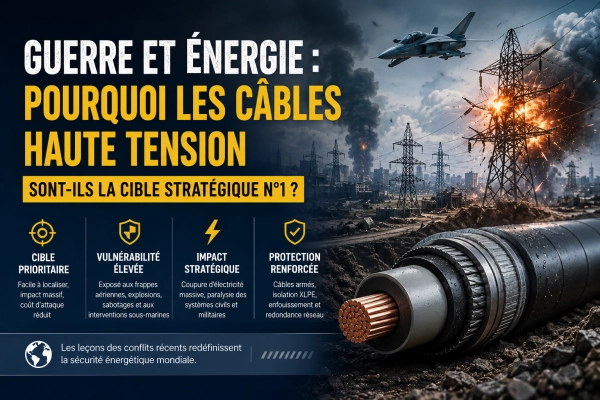
Why are electrical infrastructures priority targets? ?
Electricity, pillar of critical systems in war
In a conflict situation, electricity is not only a civil need, but a fundamental element in the functioning of military systems. Command devices, communications networks, radar systems, as well as defense-related industrial production all rely on a continuous power supply.
In this context, interrupting power supplies immediately disrupts operational capabilities. The power cut simultaneously affects civil and military infrastructure, creating a rapid imbalance on the ground.
High voltage cables, as the primary medium for long-distance electricity transmission, play a central role in this system. They constitute the backbone of the energy system in times of war, ensuring continuity of power supply between production areas and strategic centers.
A domino effect on the economy and national security
In the event of a targeted attack on electrical infrastructure, the effects are immediate and systemic. Short term, a power interruption can cause transportation systems to shut down, the disorganization of military and civil communications, as well as the disruption of energy supply chains.
In a war context, these failures greatly reduce the capacity for reaction and coordination, by limiting access to information, to logistics and essential resources.
Longer term, prolonged network degradation compromises industrial production, particularly in defense-related sectors. Business continuity becomes difficult to maintain, which directly affects the ability of a state to sustain a war effort over time.
In this dynamic, THE high voltage cables appear as a critical point. Their failure acts as a trigger, amplifying disruptions across the distribution network and transforming a local incident into a systemic crisis, with direct implications for energy security.
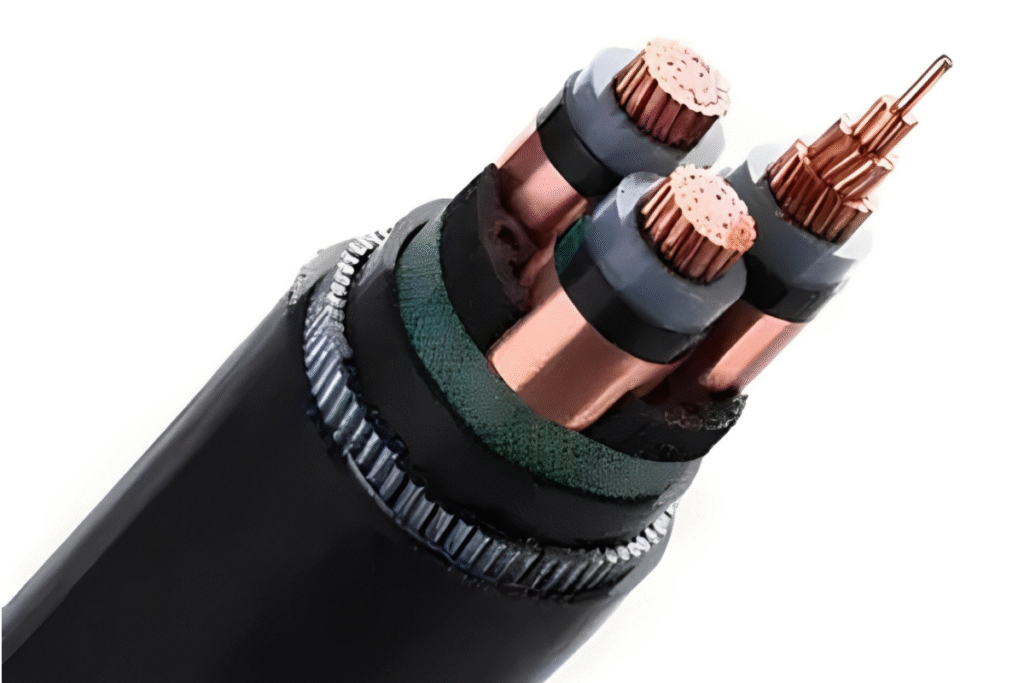
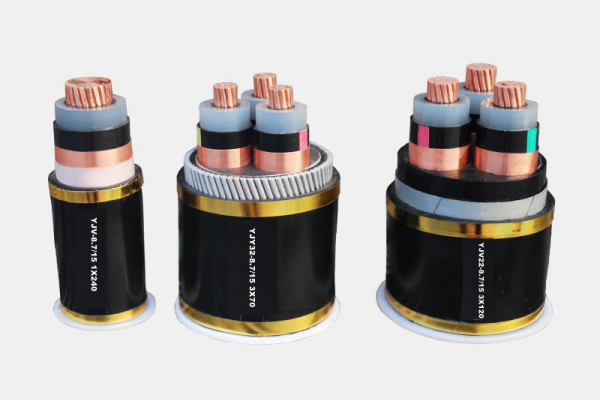
150/127/220 kV Cable
N2XS2YY cable
IEC cable 62067
High voltage cables, critical and vulnerable link
Why are high voltage cables particularly exposed ?
In a war context, high voltage cables have several characteristics that make them preferred targets. Their route is generally fixed, their coverage extends over long distances and their function is central in the transmission of electricity. This combination makes them both easily localizable and particularly sensitive to targeted actions..
From a strategic point of view, they constitute high-yield objectives : a one-off intervention can cause large-scale disruptions to the electrical infrastructure, with a relatively limited attack cost.
Their vulnerability also varies depending on their method of installation.. Overhead lines are directly exposed to strikes and physical damage. Buried cables, although more discreet, can be damaged by sabotage actions or explosive devices. THE submarine cables, as for them, remain accessible to specific interventions, particularly via underwater equipment.
Finally, the continued protection of these infrastructures over their entire route represents a major challenge. In a conflict situation, it is difficult to secure every segment of the network, which creates significant areas of vulnerability despite existing protection devices.
The weak points of current networks
In times of war, the main threats weighing on electricity infrastructures no longer arise solely from technical constraints, but intentional actions aimed at causing rapid and widespread ruptures.
Targeted attacks – whether strikes, explosions or sabotage — constitute the dominant risk. They primarily target critical segments of the network, especially high voltage cables, to maximize the impact on power continuity.
In this context, standard cables, designed primarily to withstand typical environmental and mechanical stresses, present limits in the face of intentional aggression. The absence of reinforced mechanical protection or specific design can lead to immediate ruptures, with widespread consequences on the distribution network.
Moreover, returning to service after a major failure can be long and complex. Repair operations require safety conditions, technical resources and access to the site which are not always guaranteed in conflict zones, which prolongs interruptions and accentuates the effects on energy security.
Recent cases and geopolitical tensions
Recent armed conflicts have clearly confirmed that electricity infrastructure is now among the priority targets of modern military strategies.. High voltage cables and electricity transmission lines constitute, in this capacity, major points of impact.
In several conflict zones, targeted actions against high-voltage lines and critical network nodes led to widespread and prolonged power outages, profoundly disrupting regional food systems.
These attacks are based on a clear strategic logic : hitting high-voltage cables quickly interrupts long-distance electricity transmission, while simultaneously affecting civilian activities and operational capabilities. This type of intervention thus offers a high-impact lever, combining efficiency and relatively limited cost.
Beyond the combat zones, this reality has led many States to strengthen their protection systems. In Europe in particular, securing transmission lines and high voltage cables is now integrated into network resilience and energy security policies, with increased emphasis on monitoring, physical protection and rapid recovery capabilities.
These developments confirm an underlying trend : high voltage cables can no longer be considered as simple technical components, but as strategic assets essential to energy stability and business continuity.
Towards a new strategy for securing electricity networks
In a context of conflict, securing electrical infrastructures can no longer be limited to traditional operation and maintenance approaches. It is now based on technical choices capable of meeting three major requirements : resistance to damage, power continuity and rapid recovery capability.
Reinforcement of cables and materials
Reinforcement of high voltage cables constitutes an essential lever in the face of the risks of intentional damage. The integration of metallic armor, as in the case of armored cables, improves shock resistance, impacts and certain forms of mechanical constraints linked to degraded environments.
Moreover, the technologies ofisolation XLPE provide better stability under high load conditions, which is particularly critical in a crisis situation, where networks may be subject to unusual demands or rapid redistributions of energy.
These characteristics reinforce the ability of cables to maintain their performance in disrupted contexts, where reliability becomes a determining factor in energy security.
Burial and physical protection
Installation method plays a central role in reducing exposure to risks. Buried cables present a strategic advantage by limiting their visibility and accessibility, which reduces their vulnerability to external aggression.
In sensitive areas, burying high voltage cables therefore constitutes a preferred solution to reduce the risk of direct damage and strengthen the overall protection of the network.. This approach can be supplemented by suitable mechanical protection devices., in order to limit the impacts linked to external interventions or disturbances on the ground.
Network redundancy and diversification
Beyond physical strengthening, network resilience also depends on its design. The implementation of redundancy systems ensures continuity of power supply in the event of failure of a critical segment.
Loop architectures or multi-path configurations offer efficient alternatives to keep the distribution network functioning, even in the event of localized breakage. In a crisis situation, these devices make it possible to quickly redirect energy flows and limit prolonged interruptions.
This adaptation capacity constitutes a key element to guarantee the continuity of essential activities and strengthen the robustness of electricity infrastructures in the face of major disruption scenarios..
Expert advice for projects in high-risk areas
In regions exposed to geopolitical tensions or conflict scenarios, the design of electrical systems must integrate reinforced requirements from the initial phase of the project. The objective is no longer just technical performance, but the ability to maintain power supply in degraded or unstable conditions.
Voltage and network sizing
In high risk areas, the choice of voltage level must be anticipated based on potential load peaks and disruption scenarios. The use of correctly sized high voltage cables reduces the risk of overload and ensures better stability of the distribution network in the event of extreme stress..
Choosing cables suitable for conflict environments
In sensitive geopolitical contexts, the use of armored cables is highly recommended. Their reinforced structure offers better resistance to mechanical attack and external impacts, making it a preferred solution for high risk areas.
The use of XLPE insulation technologies also constitutes an essential standard to guarantee continuity of service in conditions of high load and unstable operation., especially in critical environments.
Continuity and resilience strategies
In projects located in potential conflict zones, network design must incorporate operational continuity mechanisms. The installation of redundant circuits or dual power systems makes it possible to limit the consequences of a local failure.
This approach is essential to avoid prolonged interruptions to the electricity infrastructure, in particular when rapid restoration of the service may be constrained by security or difficult access conditions.
Organization of maintenance and rapid response
Projects in risk areas must also include specific planning for maintenance and emergency interventions.. Reducing repair times is a key factor in limiting impacts on energy security and ensuring the continuity of essential services.
This involves setting up rapid response procedures and infrastructure allowing easier access to critical segments of the network..
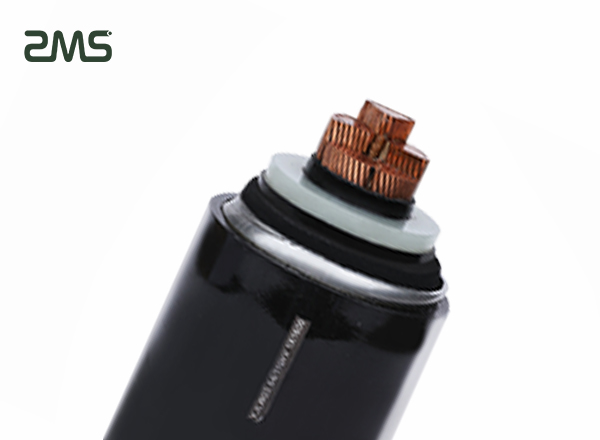
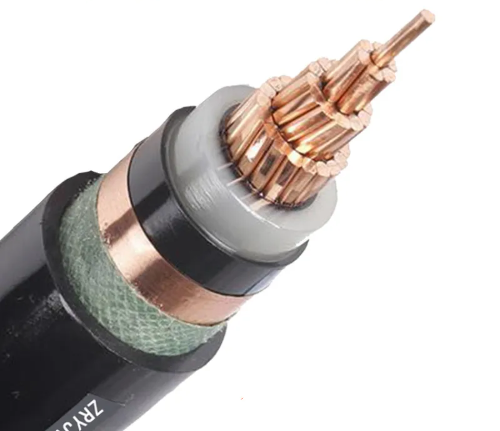
Steel tape reinforced cable
Conclusion
In a war situation, high voltage cables can no longer be considered as simple electrical equipment. They are now establishing themselves as essential strategic infrastructures, directly linked to the continuity of energy capacities, to the stability of critical systems and, more widely, to the resilience of States.
Feedback from recent conflicts shows that vulnerability or, on the contrary, the robustness of electrical infrastructure directly influences the capacity of a country to maintain its economic and operational functioning in a degraded context. Resistance of high voltage cables, their level of protection and their integration into resilient network architectures thus become determining factors.
In this context, securing electricity networks now goes beyond the simple technical field to be part of a global logic of energy security and preparation for large-scale crisis scenarios.
ZMS Cable offers tailor-made cabling solutions, designed to meet the most demanding technical requirements and environments. If you have any requests, do not hesitate to send us a description of your needs. We will send you a quote within 24 hours.