

Introduction
Ethernet cable and optical fiber are today the two main solutions for data transmission in modern networks. While the Ethernet cable relies on electrical transmission via copper conductor, fiber optics uses light signals to achieve significantly higher performance over long distances.
Faced with these differences, a question naturally arises : Ethernet cable vs fiber optic, which solution to choose for your project ?
Whether for an industrial network, a tertiary installation or external infrastructure, the choice depends above all on technical constraints, distance and budget.
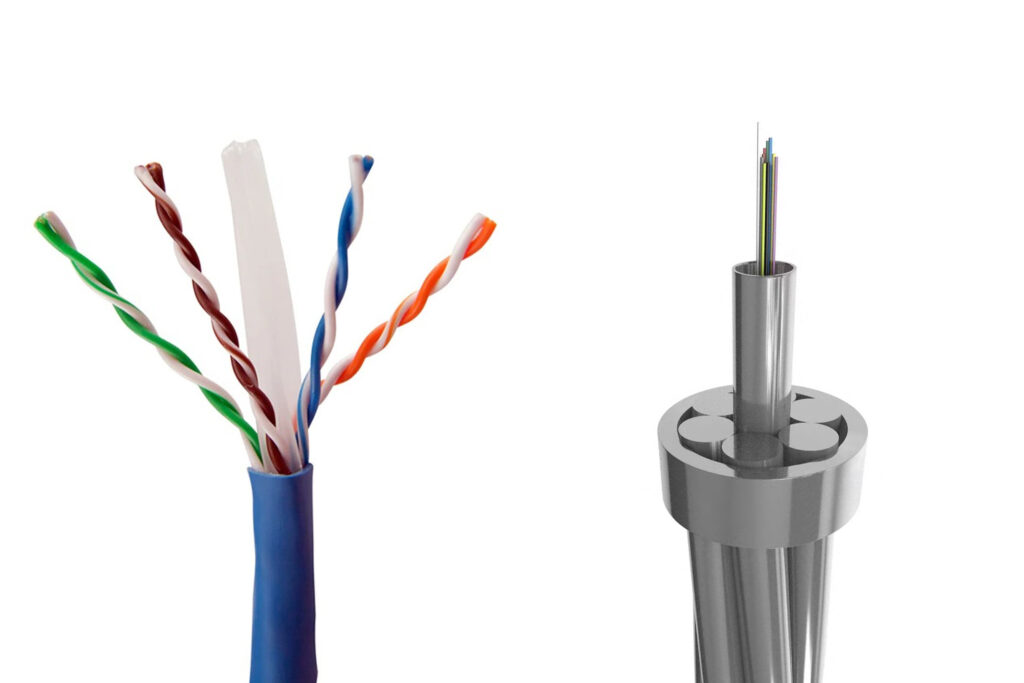
What is an Ethernet cable and optical fiber ?
Ethernet cable and optical fiber are two technologies used to ensure data transmission in computer networks, but are based on completely different principles.
In an Ethernet cable definition approach, this is a copper conductor cable enabling the transmission of electrical signals. It is commonly used in local networks (LAN), with standardized categories such as Cat5e, Cat6 or Cat7, and a range generally limited to approximately 100 meters.
Conversely, according to fiber optic definition, this transmits data in the form of light signals through glass or plastic fibers. This technology makes it possible to achieve very high flow rates and cover much longer distances., while being insensitive to electromagnetic interference.
These fundamental differences directly influence the choice between Ethernet cable and optical fiber depending on the project constraints..
Differences between Ethernet cable and fiber optic cable
The difference between Ethernet and optical fiber is mainly based on the transmission technology, performance and usage constraints.
Ethernet cable uses electrical signals through copper conductors, which makes it suitable for short distance installations and standard environments. Conversely, optical fiber transmits data in the form of light, delivering superior performance in terms of speed and distance, especially for demanding infrastructures.
In a comparison of Ethernet vs. fiber speed and Ethernet vs. fiber distance, optical fiber clearly stands out for projects requiring high speed and long-range transmission, while Ethernet remains a reliable and economical solution for local networks.
Quick comparison :
| Criteria | Ethernet cable | Fiber optics |
| Transmission | electric | bright |
| Vitesse | high | very high |
| Distance | ~100 m | several km |
| Sensitivity | electromagnetic interference | insensible |
| Cost | weak | higher |
Performance comparison
Performance analysis between ethernet cable and optical fiber must be based on measurable criteria such as speed, the distance, stability and reliability in real operating conditions.
Transmission speed
Fiber optic vs Ethernet speed mainly depends on the type of media used.
Copper Ethernet cables today offer high performance :
- Cat5e : until 1 Gbps (100 m)
- Cat6 : 1 Gbps (100 m) and until 10 Gbps over short distance (~55 m)
- Cat6A : until 10 Gbps (100 m)
Optical fiber allows us to go further :
- Multimode : 10 has 100 Gbps over a few hundred meters
- Monomode : 10 Gbps to 100 Gbps+ over several kilometers
Optical fiber therefore constitutes a more scalable solution for networks with high traffic growth..
Distance maximale
The Ethernet cable vs fiber distance is a structuring factor in the design of a network.
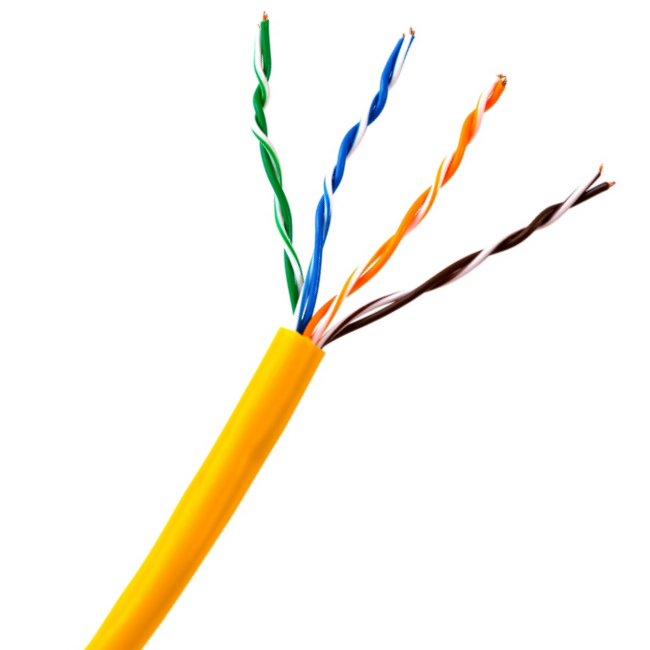
Copper Ethernet links are limited to approximately 100 meters without active equipment, which makes them suitable for local networks.
Optical fiber makes it possible to largely overcome this constraint :
- Multimode : suitable for intra-building connections
- Monomode : used for long distances (several kilometers to tens of kilometers)
The choice depends directly on the topology and the extent of the site to be equipped.
Stability and interference
In standard environment, both solutions offer good stability.
However, in industrial or highly electrified environments :
- copper cables can be affected by electromagnetic interference
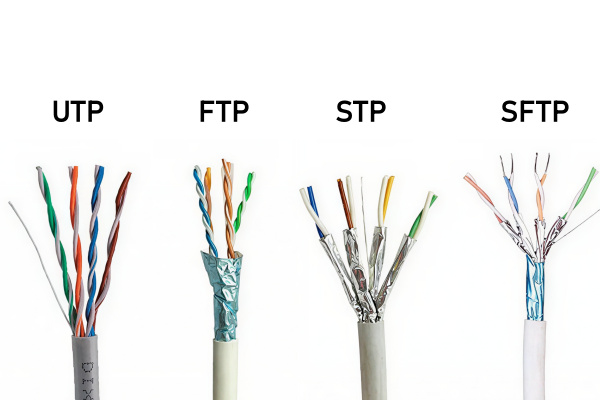
- shielded cables (STP / FTP) improve resistance but do not completely eliminate the risk
Optical fiber, completely insensitive to electromagnetic disturbances, guarantees stable transmission even near industrial equipment (engines, variators, power lines).
Latency and reliability
Latency and reliability become critical in high-demand networks (data centers, industrial automation, control systems).
Optical fiber offers :
- very low latency over long distance
- high signal stability
- better immunity to external disturbances
The Ethernet cable remains perfectly suited to local networks, but its performance depends more on the installation conditions and the environment.
Cost and installation : Ethernet vs fibre
The overall cost of a project is not limited to the cable, but includes all the infrastructure and installation constraints.
Copper Ethernet cable has an immediate advantage :
- reduced purchasing cost
- standard connectors (RJ45)
- quick installation without specialist equipment
Optical fiber involves a higher initial investment :
- optical modules (SFP, SFP+, etc.)
- compatible active equipment
- connection operations (soldering or specific connectors)
- skilled labor
On the other hand, in the long term :
- the fiber optics offers a longer lifespan (10–20 ans)
- it allows you to increase flow rates without replacing the cable (change of modules)
- copper often requires upgrades (Cat5e → Cat6 → Cat6A)
The choice must therefore integrate both the initial budget and the network development costs..
Applications : in which cases to choose each solution ?
The choice between Ethernet cable and optical fiber depends on the type of infrastructure, distance and environmental constraints.
Residential and tertiary networks
In buildings and offices, the Ethernet cable remains the preferred solution for internal connections (workstations, network equipment).
Its ease of installation and controlled cost make it a standard for local networks.
Industrial networks
In industrial environments, the choice of cable strongly depends on physical and electromagnetic constraints. The main criteria to take into account are :
- the level of electromagnetic interference
- mechanical constraints (flexion, vibrations, repeated movements)
- environmental conditions (temperature, humidity, presence of oils or chemicals)
In terms of transmission :
- unshielded Ethernet cables (UTP) are sensitive to electromagnetic disturbances
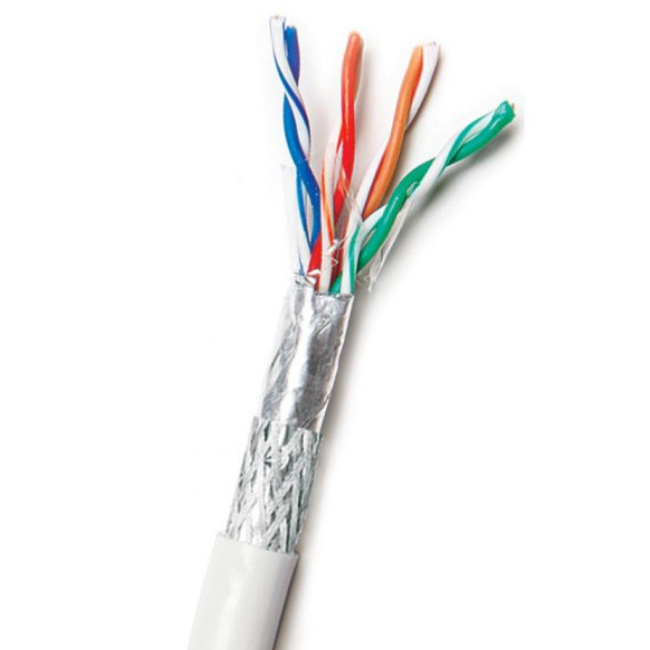
- shielded cables (STP / FTP) offer better protection and are generally used for short connections in industrial environments
- optical fiber is completely insensitive to electromagnetic fields, which guarantees maximum stability
In industrial networks (Profinet, EtherCAT, Ethernet/IP), Shielded Ethernet cables are commonly used for local connections, while optical fiber is favored for :
- critical connections
- heavily disturbed environments
- long distance communications between devices
In highly disturbed environments, optical fiber remains the most reliable solution to guarantee continuity of service.
Other essential technical criteria :
- temperature resistance
- resistance to oils and chemical agents
- flexibility and resistance to torsion cycles
- fire behavior (LSZH, flame delayer)
Outdoor installations and long distances
For extended infrastructures, inter-building connections or external networks, optical fiber emerges as the most suitable solution.
Its ability to transmit over long distances without significant loss and without sensitivity to disturbances makes it a standard choice for backbone networks.
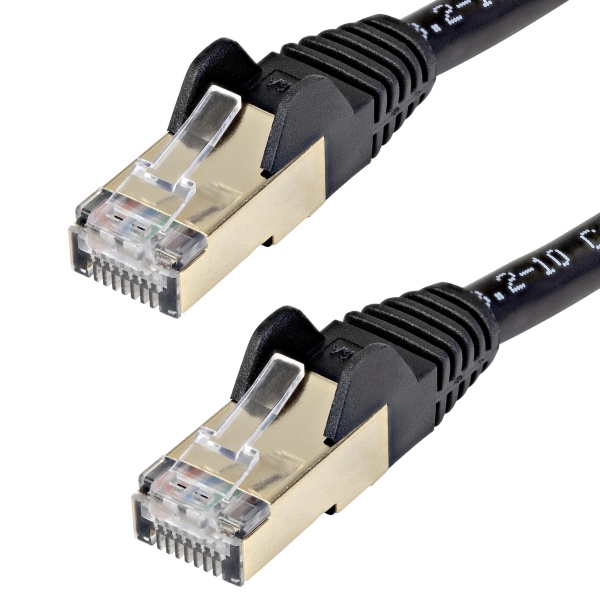
Ethernet cable
Ethernet or fiber optic cable : how to choose ?
The choice between fiber or Ethernet must be based on a global approach integrating the technical and economic constraints of the project.
Main decision criteria :
- Distance < 100 m → Ethernet cable
- Need for very high speed / scalability → optical fiber
- Electrically disturbed environment → optical fiber
- Quick and economical installation → Ethernet cable
- Equipment power requirement → Ethernet cable (PoE)
Key point often overlooked :
Ethernet cable allows power via PoE (IP cameras, Wi-Fi hotspots, phones), while optical fiber requires a separate power supply.
Recommended architecture in most projects :
In practice, a hybrid architecture is often used :
- Optical fiber for the backbone (longue distance, high speed)
- Network switch (distribution)
- Ethernet cable for final connection of equipment
This approach makes it possible to optimize both costs, network performance and flexibility.
ZMS Cable expert advice
In real projects, the choice between Ethernet and optical fiber is often poorly sized.
Two common mistakes :
- oversize fiber for simple local networks
- underestimate the constraints of an industrial copper environment
At ZMS Cable, we recommend :
- to precisely analyze real distances
- to anticipate future flow needs
- adapt the type of cable to environmental constraints
Good network design generally relies on an optimized combination of the two technologies.
Conclusion
The choice between Ethernet cable and fiber optic cable depends primarily on the distance requirements of the project, performance, cost and environment.
The Ethernet cable remains a reliable solution, economical and simple to deploy for local networks, while optical fiber offers superior performance and better scalability for large and critical infrastructures.
To guarantee a suitable and sustainable choice, it is essential to rely on a global technical analysis rather than on a single criterion.