
A cable failure during operation, it’s a stationary machine, a team waiting and a production falling behind schedule. When a mining cable wears out faster than expected, the reflex is often to question the quality of the product.
The reality is generally more nuanced. Premature failure most often results from several factors combined : the way the equipment moves, installation conditions, the mine environment, the choice of cable and its electrical sizing. A well-made cable can also fail too early if it is not adapted to the use imposed on it..
This article reviews six causes of premature wear to identify. You will also find a diagnostic table to go from a symptom to its probable cause., as well as a list of checkpoints to reduce the risk of failure. To discover our solutions, See our page dedicated to cables for mining applications.
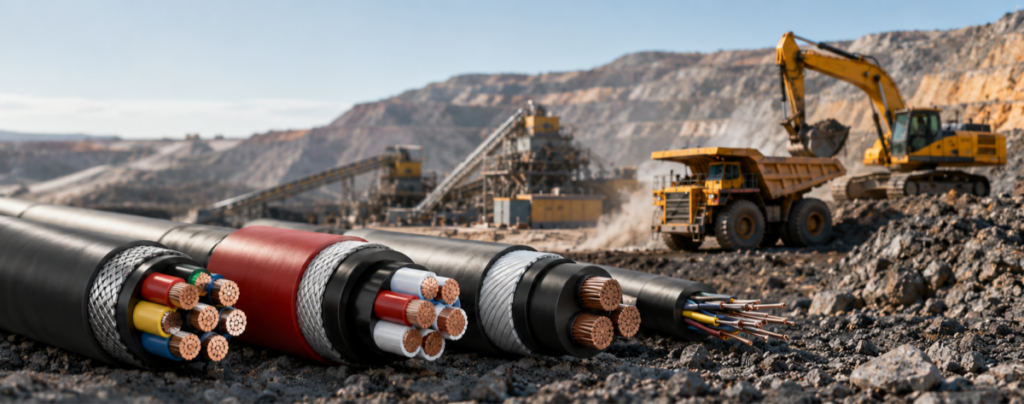
1. External mechanical constraints : abrasion, crushing and shocks
Visible symptoms
Sheath thinned or pierced on one side only, crushed or nicked areas, deformed armor if applicable.
Mechanism
The cable rubs against the rock, metal edges or the floor : the sheath gradually wears out. On the contrary, the passage of heavy machinery or falling blocks causes occasional damage.. These are more discreet : a crush or nick doesn't always cut off power right away, but weakens the cable, which ends up giving way at this location under the effect of bending or traction.
Prevention
- Choose a route that avoids sharp edges and traffic areas.
- Protect machine passages with supports, passage protections or sheaths.
- Secure the cable at regular intervals so that it does not drag or dangle.
- Inspect the sheath regularly, especially at points of contact.
When the choice of cable is in question
Too thin a sheath, or without suitable mechanical protection, in a very abrasive or impact-exposed area. Specify the exposure level when requesting the cable.
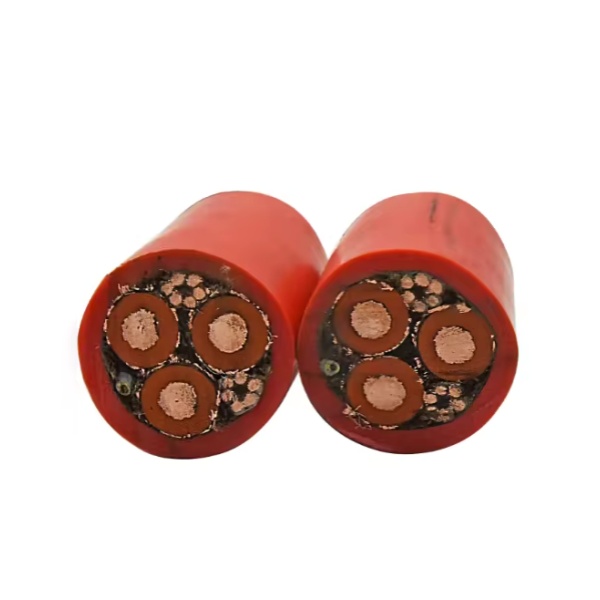
2. The flexion, torsion and tensile forces
Visible symptoms
Broken conductors near a mounting point or connection, cracked jacket where the cable bends, twisted or spirally deformed cable.
Mechanism
On mobile equipment, the cable is bent, twisted and pulled constantly. Driver fatigue is cumulative : the strands end up breaking where the stress is greatest, often at the level of a fastener or where the radius of curvature is smallest. In dynamic application, driver flexibility is not enough : tensile strength, the cabling structure and the strength of the sheath are just as important.
Prevention
- Respect the minimum curvature radius, including in the extreme positions of the machine, and not just at installation.
- Provide strain relief at fixing points rather than rigid tightening.
- Avoid the cable being stretched or twisted while moving.
- Distinguishing dragging from drum winding : the constraints, and therefore the construction of the cable, are not the same.
When the choice of cable is in question
A fixed lay cable or standard flexible cable used on continuously moving equipment. For these uses, orient yourself towards rubber cables designed for repeated movement.
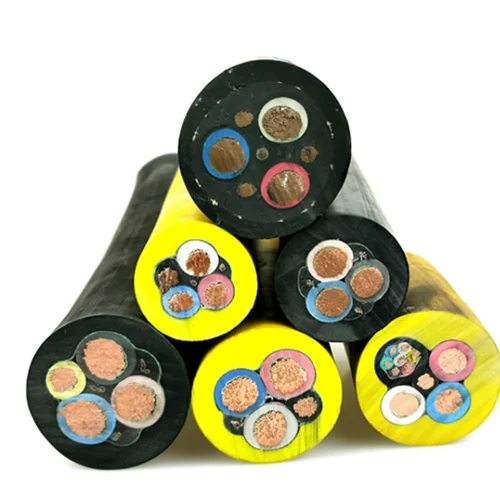
3. Humidity, oils, chemicals and UV
Visible symptoms
Inflated sheath, softened or sticky ; cracked or mealy surface ; sheath hardened and cracked by the cold ; traces of humidity or infiltration near the connections.
Mechanism
Each sheath material reacts differently to oils, to chemicals, to water and solar radiation. When the material is not adapted to the environment, it swells, hardens or cracks, and the sheath loses its protection. Conditions vary by mine : in gallery, permanent humidity, seepage water and machine oils ; open air, UV and temperature differences. Heat softens the sheath, the cold makes it brittle, and the water that penetrates eventually reaches the insulation.
Prevention
- Before choosing the cable, list the environments to which it will be exposed : oils, chemicals, eau, soleil.
- Avoid allowing the cable to remain submerged or bathed in puddles.
- Limit direct exposure to the sun, including during storage.
- Regularly check the surface condition of the sheath.
When the choice of cable is in question
A sheath material that does not correspond to the environments actually present on site. If the sheath swells, hardens or cracks without other apparent cause, the material is to be questioned.
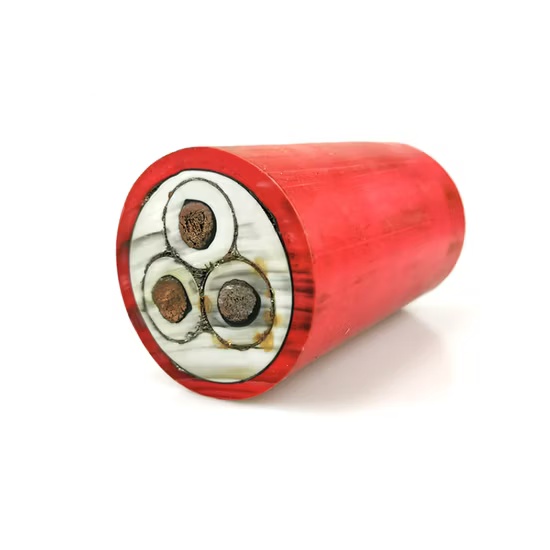
4. A cable unsuitable for the type of movement
Visible symptoms
Broken conductors or cracked sheath shortly after commissioning, always in the same places : flexion zones, around the reel or drum, fixing points on the mobile part.
Mechanism
Each cable construction is designed for a specific type of movement. We distinguish three situations : fixed pose, occasional travel and continuous movement, trailing or winding. A cable used outside its domain ages quickly, even if it is well manufactured and well installed. The most common mistakes : a fixed installation cable mounted on mobile equipment, and flexible cable standard subject to continuous dragging, or a cable intended for dragging used on a reel.
Prevention
- Determine the type of movement before looking at the tension or section : fixe, occasional or continuous.
- Estimate the amplitude and frequency of movements, in addition to the type.
- Check that the intended use appears in the cable technical sheet.
When the choice of cable is in question
Ici, it is the cause itself. If the failure appears quickly and is concentrated on the moving part, first check that the cable matches the actual movement type.
5. Installation errors, handling and connection
Visible symptoms
Damage appearing shortly after installation, at the level of fixings or connections : sheath marked by fold or compression, damaged conductors near cable entry, traces of water or corrosion at the junction.
Mechanism
A cable can be damaged even before it is put into service. Too tight a radius of curvature, twisting during unrolling or excessive traction during installation weakens the internal structure, without always leaving a visible trace. Fixing too tight crushes the sheath, fixing too far apart leaves the cable hanging and rubbing. At connection, poorly done sealing allows water to penetrate, and insufficient tightening causes overheating. Storage matters too : a cable left in the sun or in water deteriorates before being laid.
Prevention
- Unwind the cable from the spool without twisting or pulling it beyond the tensile limits.
- Respect the minimum curvature radius during installation, not just on duty.
- Use suitable collars, evenly spaced, without crushing the sheath.
- Have connections and sealing carried out by qualified personnel, and store the coils away from sunlight and water.
When the choice of cable is in question
Rarely. If the damage appears upon installation or at the level of the connections, installation is the first thing to check.
Inadequate electrical sizing
Visible symptoms
Discolored sheath, deformed or softened over a long length, without traces of abrasion or shock. Frequent triggering of protections, voltage drop at the end of the line, difficult starts.
Mechanism
Ici, the cause is no longer mechanical but thermal. When the section is insufficient or the supply distance too long, the cable heats up and the voltage drops at the end of the line. This heating ages the sheath and the insulation, even if the cable has not undergone any mechanical stress. The installation conditions aggravate the phenomenon : a cable left wound on its drum, laid in a bundle or buried, dissipates heat poorly, and its admissible current must be reduced (downgrading). The starting current of the motors adds an additional constraint.
Prevention
- Check operating current, the distance and the admissible voltage drop before choosing the section.
- Apply derating when cable is coiled, grouped or buried.
- Take into account the starting current of the motors.
When the choice of cable is in question
A section too weak for the current, the distance or installation conditions. A well-built but undersized cable will still heat up.
Diagnostic Chart : from symptom to probable cause
The same symptom can have several origins. This table indicates the most probable track, to be confirmed on site.
| Visible symptom | Cause probable | Section |
| Sheath thinned or pierced on one side only | Abrasion | 1 |
| Crushed or cut area | Crushing, choc | 1 |
| Broken conductors near a fixture or fitting | Flexion, traction, fixation | 2 et 5 |
| Inflated sheath, softened or sticky | Oils, chemicals | 3 |
| Cracked or mealy surface | UV, aging, cold | 3 |
| Rapid failure in moving area | Cable unsuitable for movement | 4 |
| Damage upon installation, water at the fittings | Installation, connection | 5 |
| Discolored or deformed sheath along entire length | Surcharge, warm-up | 6 |
And if the fault comes from the cable itself ?
A manufacturing defect remains possible. It manifests itself by repeated failures in the same place, on several cables from the same lot, despite correct installation and normal conditions. In this case, keep photos of the break point, duration of service and operating conditions, then ask the manufacturer for the test report and traceability of the batch.
How to reduce the risk of failure ?
- Identify the type of movement before choosing the cable.
- Check the current, the distance and installation conditions.
- List the environments present : oils, chemicals, eau, soleil, temperatures.
- Lay and store the cable professionally.
- Regularly inspect the conduit and fittings, and treat any damage without delay.
For technical advice, contact our team indicating the type of equipment, the tension, the length, the type of movement and the environment.