

Airport cables
Airport infrastructures rely on numerous electrical and technical systems. They cover the runway lighting, boarding bridge control systems, terminals and ground equipment. THE cables for airports ensure the power supply, track lighting, equipment control and data transmission. Depending on the applications, they must meet specific requirements : tension, flexibility, mechanical resistance, fire safety and installation conditions.
ZMS CABLE offers custom airport cables, designed to meet the needs of airport projects, with standard and personalized solutions conforming to the specifications of each project.
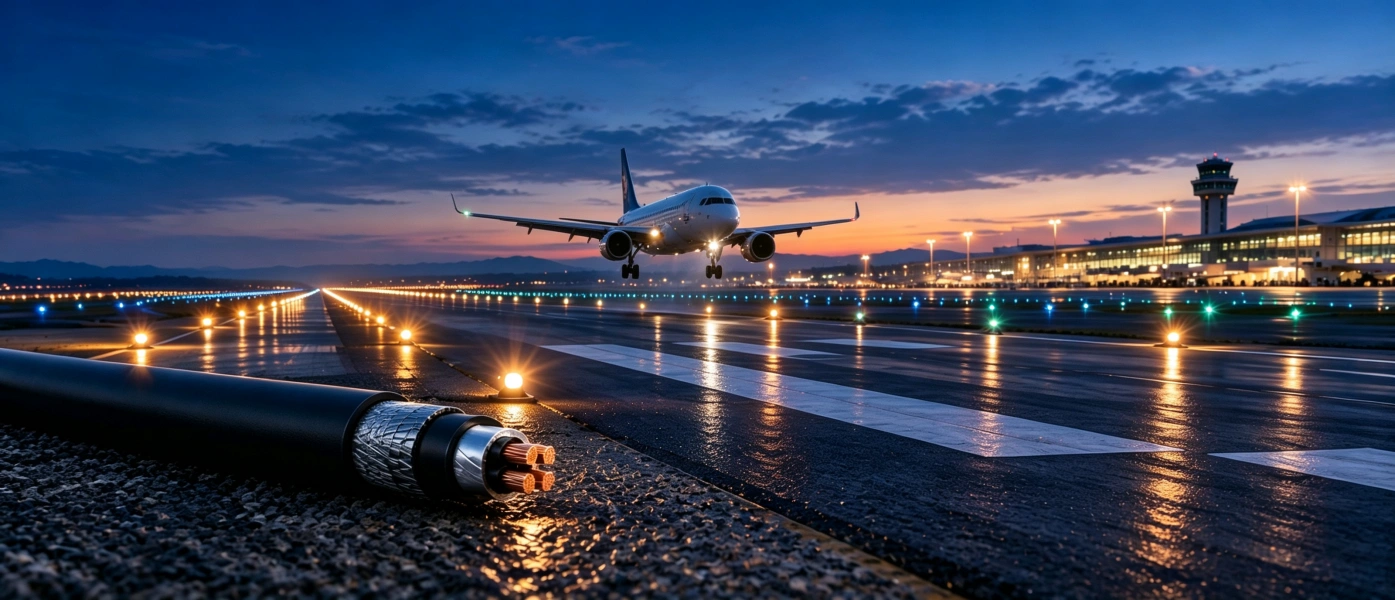
Types of airport cables
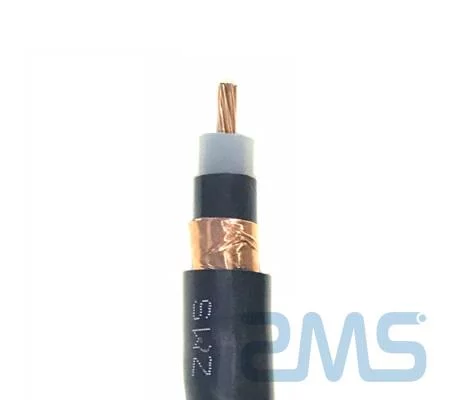
Câbles d'éclairage aéroportuaire
The airport lighting cable, also called runway marking cable, powers the runway lights, taxiway and approach. It must guarantee continuous reliable operation, including in difficult outdoor conditions.
These cables are divided into two categories, according to their position in the lighting circuit. The primary cable, in medium voltage (norms NF C33-225 In France, FAA L-824 in the United States), connects the current regulator to isolation transformers along the track ; the secondary cable connects each transformer to its fire. Both work together in series circuit : this is a significant difference compared to conventional lighting wiring, and it directly influences the type of cable to use at each stage.
The choice between these categories, and the exact structure of the cable (insulating, sheath, section), then depend on the project : track length, type de sol, climat local, required standard. Details in How to Choose a Cable for an Airport Project.
Typical applications : Runways · Taxiways · Approach zones · Aprons
ZMS Consulting : each airport lighting project has its own terrain and climate constraints, this is why our structural engineers design the cable from project data rather than offering a standard product. Project reference : Ulaanbaatar airport (Mongolia), Adelaide Airport (Australia).
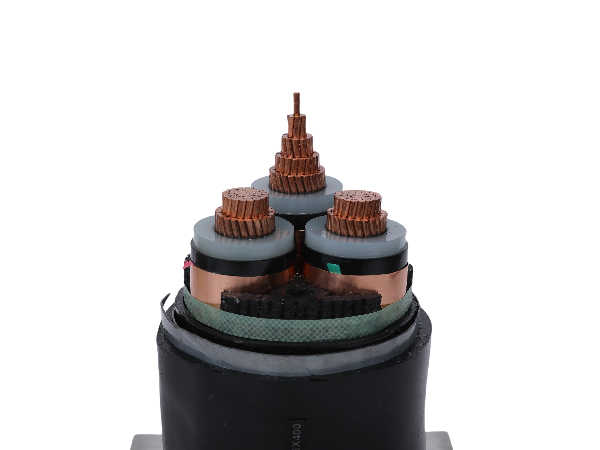
Airport power cables
The power cable ensures power supply to buildings, airport equipment and facilities, from transformation stations to consumption points.
Two voltage levels generally coexist on an airport site. The medium voltage cable (NF C33-226 in France, IEC 60502-1) distributes energy between delivery stations and transformation stations distributed across the site. The low voltage cable (NF C33-209/210) then connects each station to the buildings and equipment it supplies.
Unlike a classic building, an airport cannot tolerate cuts to its critical loads (terminal, control tower, security systems) : the feed is often looped or doubled, which influences the sizing and sometimes the structure of the cable.
Typical applications : Transformer stations · Terminal buildings · Technical buildings · Runway equipment
ZMS Consulting : two points are often underestimated at the time of sizing. First of all, on a looped or doubled feed, the cable and its protection must be sized to take up 100 % of the load in the event of failure of one of the two sources — not just the distributed load in normal operation, which is weaker. Ensuite, medium voltage sections passing under an apron or a taxiway support axle loads much higher than those of conventional roads : the burial depth and mechanical protection of the cable must take this into account, beyond standard installation rules. Our structural engineers dimension according to the actual distribution diagram of the project, not a single standard voltage level.
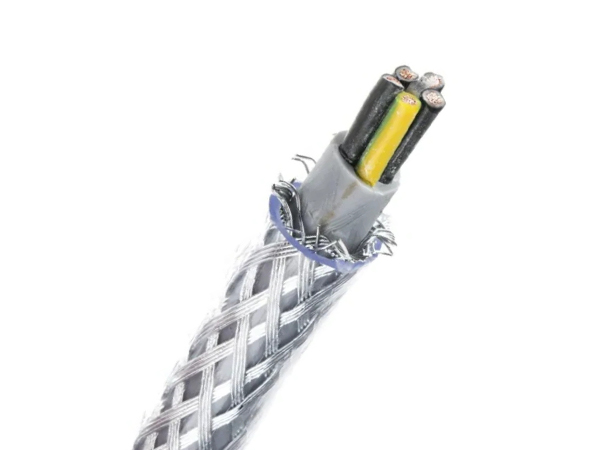
Control and command cables
The control and command cable transmits start/stop orders, feedback signals and status information between airport automation systems and electromechanical equipment — baggage sorting conveyors, automatic doors, technical equipment.
It differs from the power cable by its function (signal, no charging current) and by its structure : small section conductors, often multi-pair, with shielding against electromagnetic disturbances.
In a baggage sorting system, control cables often run in parallel, over long distances, with the power cables that power the conveyor motors. This proximity exposes the signals to disturbances generated by frequency variators : Insufficient shielding results in reading errors or unexpected shutdowns, often difficult to diagnose once the system is operational.
Typical applications : Baggage sorting systems · Technical equipment · Doors and automation · Boarding bridges (order part)
ZMS Consulting : on routes where control cables and power cables run together, spacing and shielding must be defined at the design stage, not corrected after the fact — rewiring a baggage sorting system in operation is costly in terms of downtime. Download the shielded control cable datasheet for airport environments (lien PDF). For other uses of the control cable, check out our control cables page.
Signal cables for navigation and surveillance
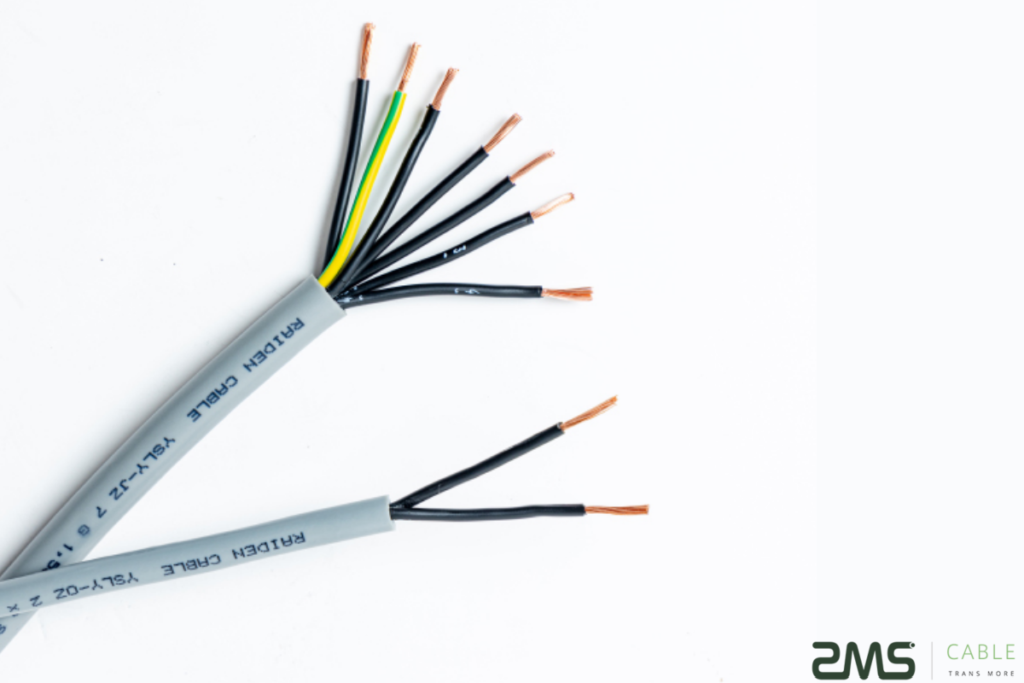
Navigation assistance systems (ILS, radars, tags) and monitoring (video surveillance, access control) transmit low energy signals that require very high transmission integrity — unlike the control signal of mechanical equipment, here the slightest alteration of the signal can distort a measurement or an image.
According to the system, the airport signaling cable takes different forms : coaxial cable controlled impedance (50 or 75 ohms) to connect antennas and radar or ILS equipment, shielded data cable for cameras and access control systems. Lighting control-command systems (control cabinets, supervision) fall under the norm NF EN 50490.
The often overlooked point is not the cable itself, but the shielding continuity : a mass poorly attached to a single connection, on a route of several hundred meters, is enough to reintroduce the disturbances that the shielding was supposed to eliminate - with a direct risk to the reliability of a navigation system.
Typical applications : Navigation aids (ILS, radars) · Video surveillance · Access control · Supervision of lighting markings
ZMS Consulting : on these circuits, our structural engineers check the consistency of the shielding over the entire route, fittings included — not just the cable spec alone.
Flexible cables for airport equipment
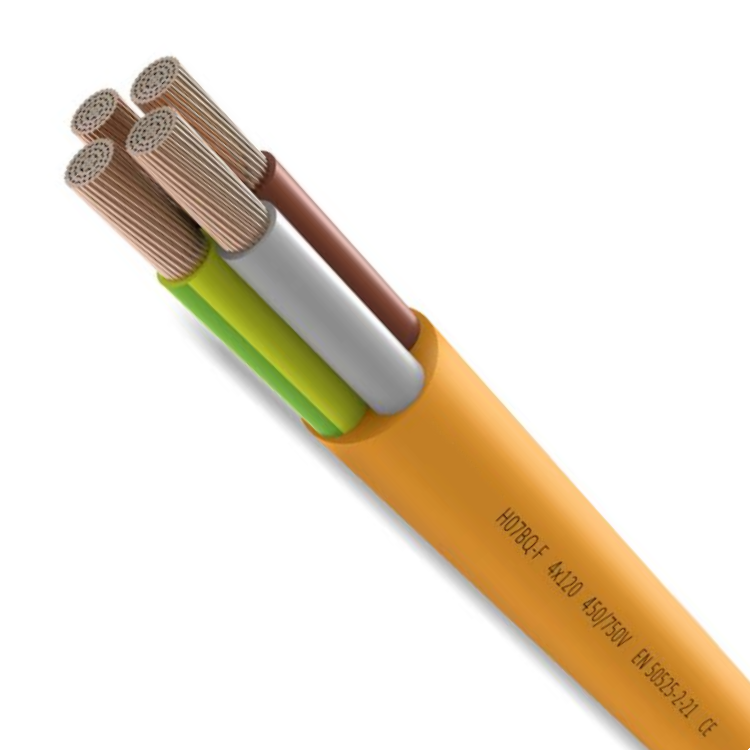
Some airport equipment is mobile or subject to repeated movements — boarding bridges, park generators (GPU), push-back tractors, track equipment. The cable that powers them must remain flexible and reliable after thousands of bending cycles, not just at the time of installation.
This distinguishes the airport flexible cable a standard fixed cable : fine strand conductor (class 5 or 6) to support repeated bending without fatigue, oil resistant rubber jacket, to UV and cold — often of the type H07RN-F, current on external equipment subject to these constraints.
The often underestimated point : a poorly chosen flexible cable does not break immediately, he gradually gets tired inside, on the strands or at the junction with the connector. On a boarding bridge (repeated movement, sometimes with reel), resistance to torsion counts as much as resistance to simple bending — a point rarely specified in standard sheets.
Typical applications : Boarding bridges · Park generators (GPU) · Push-back tractors · Track equipment
ZMS Consulting : on reel or repeated motion equipment, we systematically ask for the expected number of cycles and the mode of movement (flexion, torsion, or both) before sizing the cable — a criterion often absent from the initial specifications. Find other uses on our flexible cables page.

Communication cables and fiber optics
An airport's communications network connects buildings often several hundred meters to several kilometers apart — terminals, control tower, technical buildings — for voice, data and monitoring systems.
Over these distances, the copper cable (Ethernet) quickly reaches its limit of 100 meters. The fiber optics takes over : single-mode for long connections between buildings (backbone), multimode for distribution inside the same building. Fiber also has the advantage of being insensitive to electromagnetic disturbances generated by surrounding power equipment – a criterion which weighs more on an airport site than in a conventional building..
A point often forgotten when choosing : in areas accessible to the public (terminals, boarding areas), the cable must meet a reaction to fire classification (Euroclasses Cca, B2ca according to the CPR regulation) — a requirement specific to buildings open to the public, distinct from the electrical or optical characteristics of the cable, and sometimes absent from specifications written only in terms of flow and distance.
Typical applications : Inter-building connections · Terminal networks · IP supervision and video surveillance · Passenger information systems
ZMS Consulting : beyond flow and distance, we systematically ask if the route passes through a public zone – the required fire classification may change the structure of the cable, not just its outer sheath. Find other uses on our page communication cables.

Cables for security systems
Fire safety systems (detection, smoke extraction, alarm) must remain operational during the evacuation, even when the fire has already reached the cable itself — this is a different requirement than the simple reaction to fire seen for communications cables.
The fire resistant cable (CR1, norm NF EN 50200) maintains its electrical function typically 30 has 120 minutes in a fire situation, depending on the system powered. It is distinguished from simply halogen-free and low-smoke cable (LSZH/LSOH, IEC 61034) : the latter limits the spread of fire and the toxicity of smoke on its own route, but does not guarantee continuity of operation during fire. The two criteria are often confused, while they meet distinct regulatory requirements.
On an airport, the choice between the two depends on the system served : a smoke extraction or alarm that must continue to operate during evacuation requires a fire-resistant cable ; a current cable in a public area, without this requirement of continuity, can be limited to LSZH.
Typical applications : Fire detection · Smoke extraction · Evacuation alarm · Security lighting
ZMS Consulting : the most common confusion in specifications is to require “a halogen-free cable” when the system actually needs a fire resistant cable (CR1) — the two are not interchangeable. We systematically check the system function before proposing the cable structure.
Cables suitable for different airport applications
| Airport application | Cable type | Usage principal |
| Track lighting / traffic lanes | Airport lighting cable | Power supply of runway lights, de voie de circulation |
| Electrical distribution | Power cable (MT/BT) | Building power supply, airport equipment and infrastructure |
| Terminal | Combinaison de plusieurs types | Lighting, sockets, CVC, Fire safety |
| Baggage sorting system | Control and command cable | Convoyeurs à bagages et équipements de tri automatisé |
| Boarding bridge | Flexible cable / control cable | Gateway power and control |
| Ground equipment | Flexible cable | Alimentation électrique des équipements mobiles au sol |
| Communication network | Communication cable and optical fiber | Communication, réseau, airport information systems |
| Video surveillance | Signal cable | CCTV, security, supervision |
| Navigation help | Signal cable | Équipements d’aide à la navigation et systèmes associés |
| Fire safety | Fire resistant cable / halogen-free | Détection incendie, alarm, systèmes d’urgence |
How to choose a cable for an airport project ?
Le choix d’un câble aéroportuaire dépend rarement d’un seul critère — plusieurs dimensions interviennent ensemble, selon l’application concernée.
Tension : basse tension pour la plupart des circuits secondaires et équipements, moyenne tension pour la distribution primaire et les circuits d’éclairage (voir câbles de puissance et câbles d’éclairage aéroportuaire). Le niveau de tension conditionne à lui seul une grande partie de la structure du câble.
Mode de pose : un câble enterré directement, posé sous conduit ou installé en aérien n’a pas les mêmes exigences de gaine ni de protection mécanique — une pose sous conduit tolère une gaine plus fine, un enfouissement direct l’exclut.
En savoir plus
Mechanical constraints : les tracés passant sous une aire de trafic ou une voie de circulation supportent des charges d’essieu élevées, et les équipements mobiles imposent flexion ou torsion répétée (voir câbles de puissance et câbles flexibles). Le nombre de cycles attendu et le mode de mouvement doivent être connus dès le dimensionnement.
Environment : nature du sol (corrosivité, humidity), temperature range, exposition aux hydrocarbures ou aux UV pour les équipements extérieurs. Un sol agressif ou un climat extrême peut suffire à écarter une structure standard.
Fire behavior : fire resistance (CR1, NF EN 50200) et faible émission de fumée (LSZH, IEC 61034) répondent à deux exigences distinctes, souvent confondues — la première maintient le fonctionnement pendant l’incendie, la seconde limite la propagation et la toxicité des fumées (voir câbles pour les systèmes de sécurité). Le système desservi détermine laquelle s’applique.
Applicable standard : NF C33-224/225 en France, FAA L-824 aux États-Unis, ou équivalence ICAO selon le pays. La norme exigée ne fixe pas seulement un niveau électrique, mais aussi les méthodes d’essai et les critères de réception du câble.
Tailored cable solutions for airport infrastructure

Câble d'éclairage aéroportuaire — Aéroport de Kuala Lumpur
- Câble fourni : FAA L-824 et H07RN-F
- Quantity : 12 km
- Application : éclairage et alimentation des terminaux, pistes, voies de circulation et plateformes
- Destination : Malaisie

Câble d'éclairage aéroportuaire — Aéroport (Équateur)
- Câble fourni : FAA L-824
- Quantity : 5 km
- Application : maintenance de l’éclairage de pistes pour gros porteurs
- Année : 2017
- Destination : Équateur
ZMS a également fourni le câble d’éclairage du nouvel aéroport international d’Oulan-Bator (Mongolia) et un câble d’alimentation pour l’éclairage intérieur de l’aéroport d’Adélaïde (Australia).
Un câble aéroportuaire standard couvre une partie des besoins — mais chaque piste, chaque climat et chaque schéma de distribution a ses propres contraintes. Nos ingénieurs structure conçoivent le câble à partir des données réelles du projet (tension, length, sol, climat, required standard), plutôt que d’adapter un produit standard après coup.
Discutons de votre projet — envoyez-nous vos spécifications, nous vous proposons une structure adaptée.
Our professional services
By choosing high quality overhead cables, you offer your teams and facilities a higher level of security — and this is precisely what ZMS services aim to guarantee.
ZMS designs and produces tailor-made cables according to your technical specifications, with customization of the marking, Colors and packaging. Our products can be adapted to meet international standards (GB, IEC, BS, NFC, ASTM, FROM, etc.) and the specific requirements of each project.
All cables are tested before shipment and comply with CE certifications, IEC and ISO. Detailed test reports can be provided upon request to ensure the reliability and safety of your installations.
ZMS cables are carefully packaged on wooden spools, corrugated cardboard boxes or metal drums. Ends are tightly sealed with plastic wrap or BOPP to prevent moisture. Exterior marking can be personalized with waterproof materials.
We offer flexible and fast logistics solutions to more than 130 pays :
- Maritime : 20ft or 40ft containers depending on volume.
- Land : Local or regional delivery.
- Air : Option available for rush orders.
We also provide all necessary export documents : commercial invoice, packing list, certificate of origin and customs documents.
Our engineers and advisors support you in choosing the cables best suited to your installations. We offer comprehensive consulting services, including technical assistance and project management, to ensure every step of your order is covered professionally.
ZMS offers two options for your electrical projects :
- Option A (led by ZMS) : Sending engineers and a supervision team to site to provide technical advice, installers and final tests. Travel expenses, accommodation, per diem and translation are to be expected.
- Option B (local subcontracting) : Collaboration with qualified local companies for installation, with technical training, On-site supervision and compliance verification provided by ZMS.
