
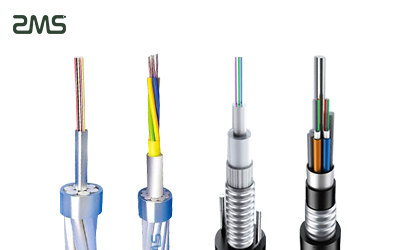
Fiber Optic Cable
The fiber optic cable is a type of cable that uses very fine glass or plastic fibers to transmit light signals. These light signals allow information to be transmitted at very high speed, making it an essential solution for communications networks, telecommunications and data infrastructure. The fibers are generally protected by different layers of sheathing and reinforcement in order to resist bending, to pressure, humidity and installation conditions.
ZMS CABLE provides fiber optic cables suitable for different deployment environments, especially for external networks, telecommunications, industrial infrastructure and communications networks. According to project requirements, we can adapt cable structure, the number and type of fibers, the outer sheath as well as the mechanical protection elements, in order to meet specific installation and transmission constraints.
Documentation technique
Fiber optic cables
Consult the technical characteristics, configurations and key specifications of our fiber optic cables to help you select the right solution for your project.
Fiber optic cable accessories
Main accessories for fiber optic cables, with their characteristics and configurations. Other solutions can be proposed depending on the requirements of your project.
Types of fiber optic cables available at ZMS Cable
Types of optical fibers (SMF & MMF)
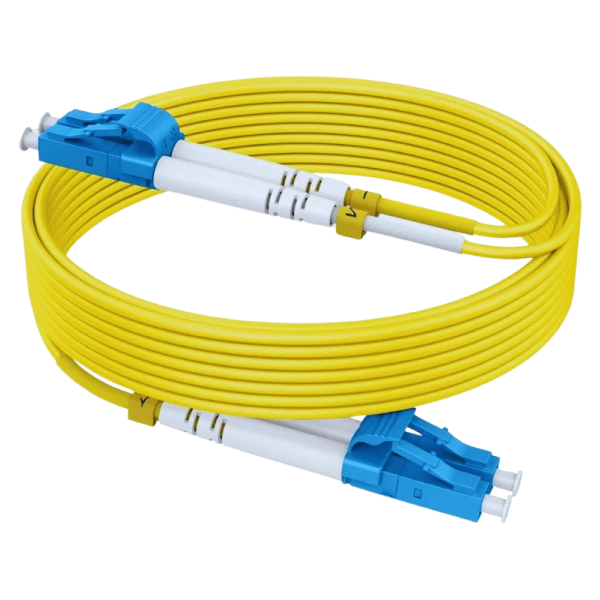
Single-mode or multi-mode optical fiber (SMF & MMF)
The fiber optics comes in two large families, single-mode fiber and multi-mode fiber, which are distinguished by the diameter of the heart, transmission distance and equipment cost. The single-mode fiber (OS1/OS2) is suitable for long distance networks — telecom, FTTH, backbone - tandis que la fibre multimode (OM1 to OM5) suitable for short connections in data centers or local networks.
Our fiber optic cables are available in single-mode or multi-mode configuration depending on the type of installation : ADSS, OPGW, OPPC for airlines ; GYTA53, GYTY53 for buried installation.
ZMS Consulting :
The choice between single-mode and multi-mode fiber depends above all on the distance to cover one you budget disponible for active equipment. For detailed support according to your project, check out our complete guide.
Submarine fiber optic cable
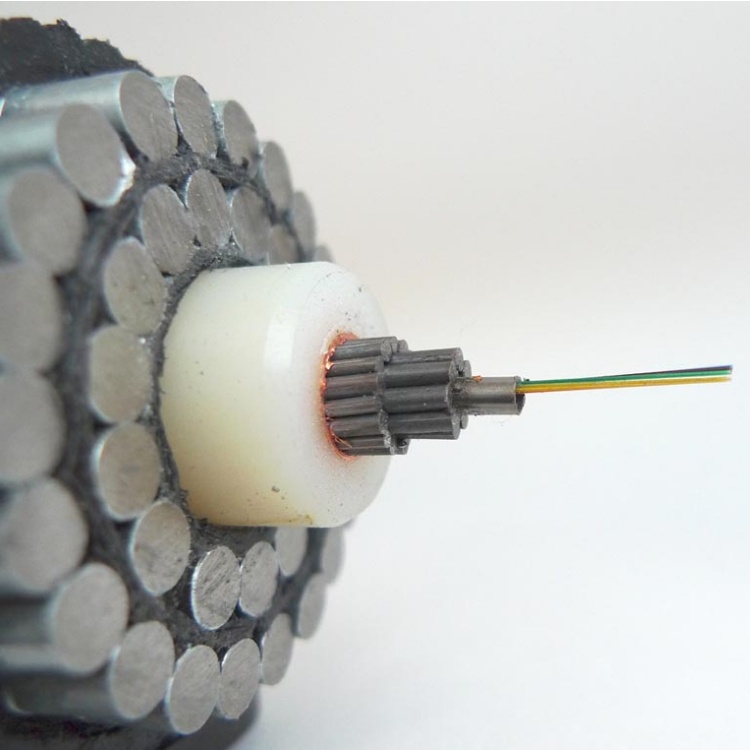
Submarine and submerged fiber optic cable
The submarine fiber optic cable is designed for data transmission across oceans, while the submerged fiber optic cable is intended for freshwater environments — rivers, lacs, tanks. Both have a reinforced structure with sealing tubes/gels and metal armor adapted to the level of mechanical risk and installation depth.
Typical applications :
- High-speed intercontinental and coastal connections
- Island and offshore platform connections
- Internet backbones and maritime telecommunications networks
- River and lake crossings for telecommunications networks
- Connection of installations on reservoirs and dams
ZMS Consulting :
The choice between oceanic submarine cable and submerged cable in fresh water depends above all on the installation environment. At great ocean depths, a lighter structure is usually enough ; near the coast, reinforced armor is recommended to resist anchors and fishing gear.
For the submerged cable in river or lake, light armor is suitable for calm, stable waters ; reinforced protection is recommended in the event of high current, flood risk, or significant river traffic (navigation, fishing, works nearby). ZMS Cable offers personalized structures according to bathymetry, the type of watercourse and the constraints of the project.
Air optical fiber cable
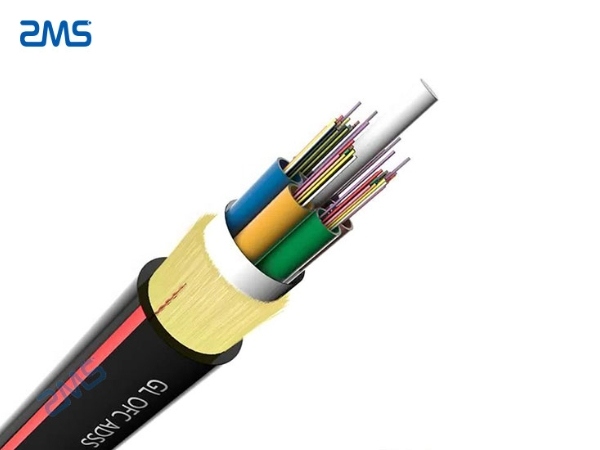
ADSS cable - self -supporting metal -free air cable
The ADSS cable (All-Dielectric Self-Supporting) is an aerial fiber optic cable without a metallic conductor. Light, Flexible and weather resistant, it is suitable for installations on telecom poles or lines medium voltage, without earthing. Its all-dielectric design makes it ideal for environments with strong electric field.
Applications :
- Aerial telecom networks
- MV power lines
- Rural or difficult to access areas
ZMS Consulting :
The choice of a ADSS cable must take into account the scope (span), climatic conditions and electrical environment.
For installations on MV or HV lines, it is recommended to use a sheath anti-tracking (AT) to ensure better sustainability.
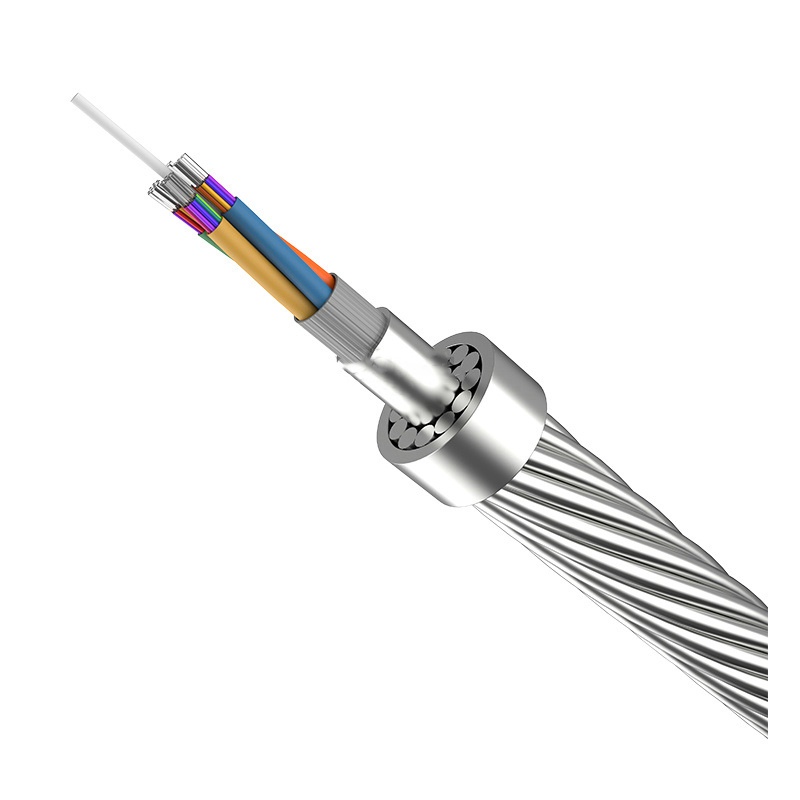
OPGW cable - Optical fiber for high voltage lines
The OPGW cable (Optical Ground Wire) is a fiber optic cable embedded in a ground conductor for high voltage lines. It ensures both the lightning protection and data transmission, by replacing the traditional guard cable. Thanks to its metal structure, it offers excellent mechanical resistance and great reliability in demanding electrical environments.
Applications :
- High voltage transmission lines
- Telecommunications networks of energy operators
- Infrastructures backbone longue distance
ZMS Consulting :
The OPGW cable is particularly suitable for new power lines or ground wire replacement projects.
His choice depends on the short circuit current capacity, mechanical constraints (scope, charge) and optical transmission requirements.
Ideal solution to integrate telecommunication et energy transport on the same infrastructure.
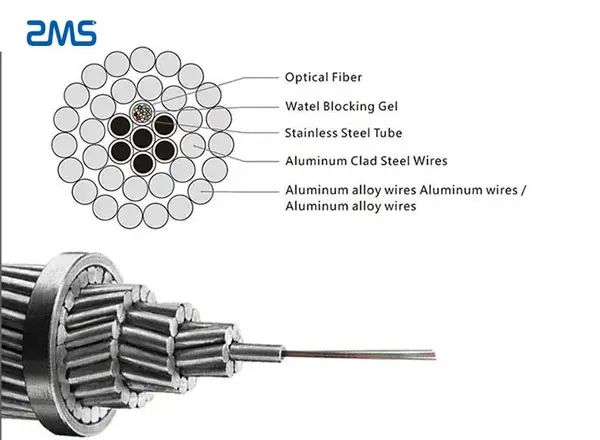
OPPC cable - Optical fiber cable integrated into the driver
The OPPC cable (Optical Phase Conductor) incorporates optical fibers directly into the phase driver of a power line. It allows the simultaneous transmission of energy and data, Without adding additional cable. Ideal solution for medium and high voltage networks, in case of space constraints or advanced integration needs.
Applications :
- Medium voltage distribution lines
- Smart power grids (smart grid)
- Projects requiring energy integration + communication
ZMS Consulting :
OPPC cable is recommended when fiber integration must be done without adding any additional cable. Its choice depends on the electrical charges, thermal constraints and required optical performance.
Comparaison ADSS vs OPGW vs OPPC
| Criteria | ADSS | OPGW | OPPC |
| Structure | 100% dielectric | Earth conductor | Phase driver |
| Metal element | Non | Oui | Oui |
| Position on the line | Suspended (independent) | Up (guard cable) | Active driver |
| Is under tension ? | Non | Non | Oui |
| Typical voltage | MT / HT (environment) | HT / THT | HT / THT |
| Main function | Telecommunication | Lightning protection + communication | Energy transport + communication |
| Typical deployment | Quick addition to existing line | New line or replacement of guard wire | New line or network modernization |
| Installation complexity | Weak | Average | High |
| Typical applications | Aerial telecom networks | Electric transmission networks | Smart grid, integrated HV lines |
ZMS Consulting
The choice between ADSS, OPGW and OPPC mainly depends on the power grid configuration and project objectives :
- ADSS : quick and economical solution for adding fiber to existing infrastructure
- OPGW : ideal for high voltage lines requiring reliability and protection
- OPPC : recommended for integrated projects combining energy transport and communication
Armored fiber optic cable
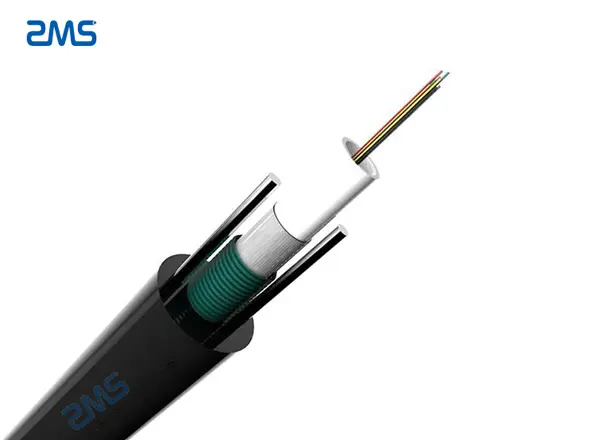
Gyxtw cable - fiber optics with compact central tube
The GYXTW cable is a compact central tube fiber optic cable, reinforced with steel wires for better mechanical resistance.
Easy to install in conduits or on poles, it is recommended for local communication networks and short distance external links.
| Technological parameters ( TOGETHER ) | ||||||
| Number of fibers | Minimum curvature radius (mm) | Minimum tensile resistance (N) | Minimum crushing resistance (N/100mm) | |||
| Static | Dynamic | Court Terme | Long Terme | Court Terme | Long Terme | |
| 2 ~ 24 | 10 times the diameter | 20 times the diameter | 1500 | 600 | 1000 | 300 |
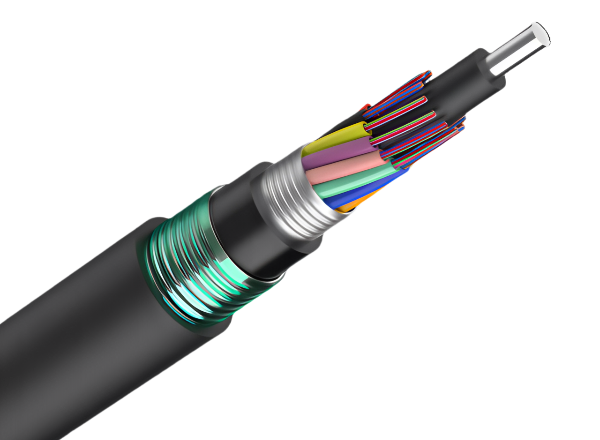
Gyta53 cable - Army optical fiber for buried direct installation
The Gyta53 cable is a double-sheathed fiber optic cable with steel armor, designed for direct buried installation in demanding environments.
Its robust structure ensures excellent protection against humidity, mechanical stress and rodents, making it suitable for long distance outdoor networks.
| Technological parameters ( GYTA53 ) | ||||||
| Number of fibers | Minimum curvature radius (mm) | Minimum tensile resistance (N) | Minimum crushing resistance (N/100mm) | |||
| Static | Dynamic | Court Terme | Long Terme | Court Terme | Long Terme | |
| 2 ~ 432 | 15 times the diameter | 30 times the diameter | 3000 | 1000 | 3000 | 1000 |
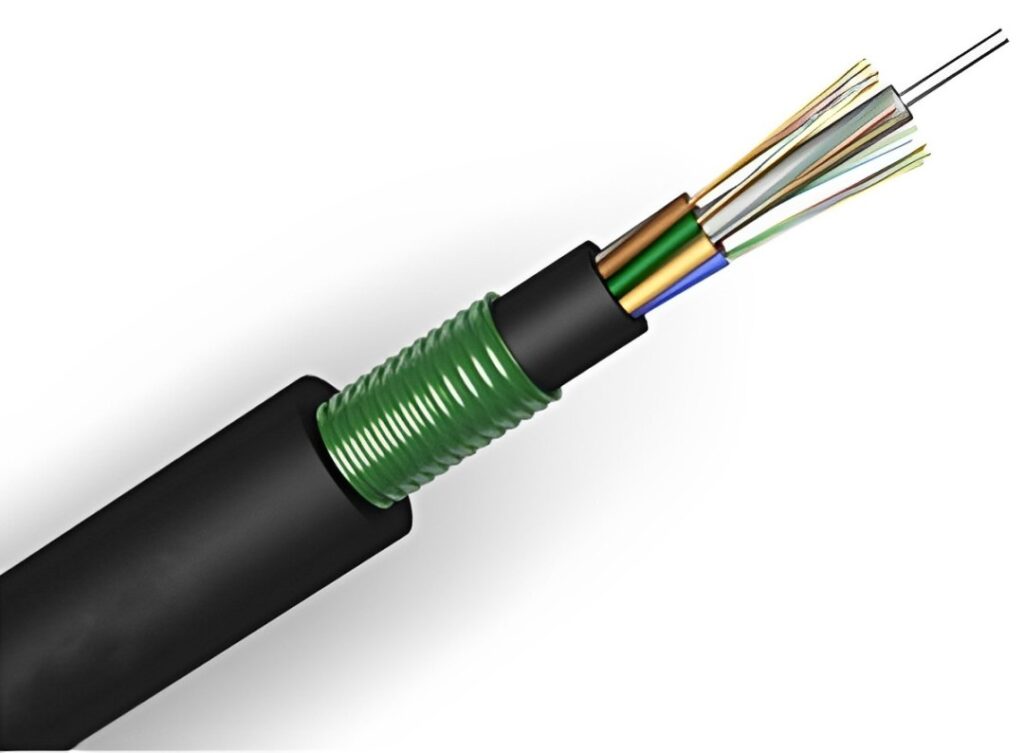
Gyty53 cable - Fiber Optics Double sheath for buried installation
The cable GYTY53 is a double-sheathed armored fiber optic cable designed for underground and industrial installations.
It offers high resistance to humidity, to mechanical pressures and external attacks, ideal for long distance buried networks.
Optical fiber for home connection
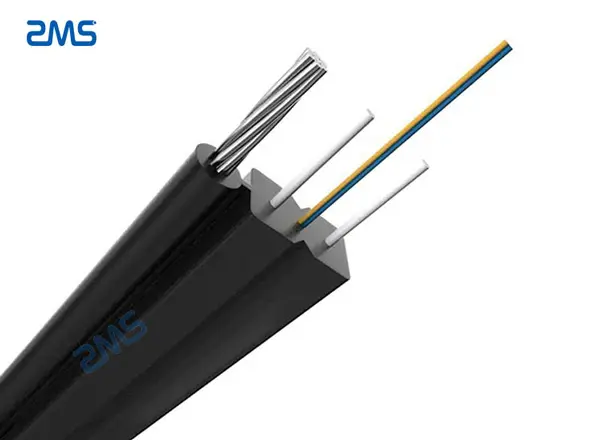
FTTH optical fiber cable
The FTTH cable (Fiber To The Home) is designed to directly connect accommodation or offices to fiber optic networks. Light, flexible and easy to install, It is perfect for indoor or final distribution applications. Ideal for high -speed access networks in residential and urban projects.
Why choose ZMS Cable for your fiber optic projects ?
- ZMS Cable provides customized fiber optic solutions for telecom networks, industrial and energy. Our cables can be adapted according to the number of fibers, the structure, the sheath, marking or specific installation requirements.
- All products are manufactured in accordance with major international standards such as IEC, BS, NFC, ASTM et DIN, with quality control before shipment and test reports available on request.
- Thanks to our experience in ADSS projects, OPGW, OPPC, FTTH and armed optical fiber, our engineers support customers in the choice of cables, installation constraints and deployment solutions.
- ZMS Cable also offers flexible logistics solutions and international technical support for fiber optic projects in more than 130 pays.
Need a fiber optic cable adapted to your project ?
ZMS Cable supports telecoms projects, industrial and energy with personalized fiber optic solutions : ADSS, OPGW, OPPC, FTTH, armored cables and long distance networks.
Contact our team to get :
- a technical recommendation
- a quick quote
- a solution adapted to your installation conditions
Our professional services
By choosing high quality overhead cables, you offer your teams and facilities a higher level of security — and this is precisely what ZMS services aim to guarantee.
ZMS designs and produces tailor-made cables according to your technical specifications, with customization of the marking, Colors and packaging. Our products can be adapted to meet international standards (GB, IEC, BS, NFC, ASTM, FROM, etc.) and the specific requirements of each project.
All cables are tested before shipment and comply with CE certifications, IEC and ISO. Detailed test reports can be provided upon request to ensure the reliability and safety of your installations.
ZMS cables are carefully packaged on wooden spools, corrugated cardboard boxes or metal drums. Ends are tightly sealed with plastic wrap or BOPP to prevent moisture. Exterior marking can be personalized with waterproof materials.
We offer flexible and fast logistics solutions to more than 130 pays :
- Maritime : 20ft or 40ft containers depending on volume.
- Land : Local or regional delivery.
- Air : Option available for rush orders.
We also provide all necessary export documents : commercial invoice, packing list, certificate of origin and customs documents.
Our engineers and advisors support you in choosing the cables best suited to your installations. We offer comprehensive consulting services, including technical assistance and project management, to ensure every step of your order is covered professionally.
ZMS offers two options for your electrical projects :
- Option A (led by ZMS) : Sending engineers and a supervision team to site to provide technical advice, installers and final tests. Travel expenses, accommodation, per diem and translation are to be expected.
- Option B (local subcontracting) : Collaboration with qualified local companies for installation, with technical training, On-site supervision and compliance verification provided by ZMS.
