
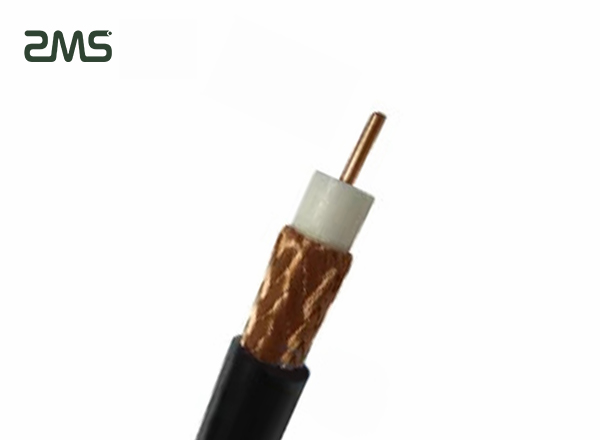
Coaxial Cable
The coaxial cable is a type of electronic cable used to transmit video signals, radio frequency (RF) and other high frequency signals. A central conductor is surrounded by an insulating layer, itself covered with metal shielding which forms a sort of Faraday cage. This concentric structure helps limit electromagnetic interference. It is used in TV and satellite distribution networks, video surveillance and radio links.
ZMS is a manufacturer of coaxial cables for distributors, importers, installers and projects. This page presents the difference between impedances 75 Ω and 50 Oh, the main types (RG-6, RG-59, RG-58) and the selection criteria.
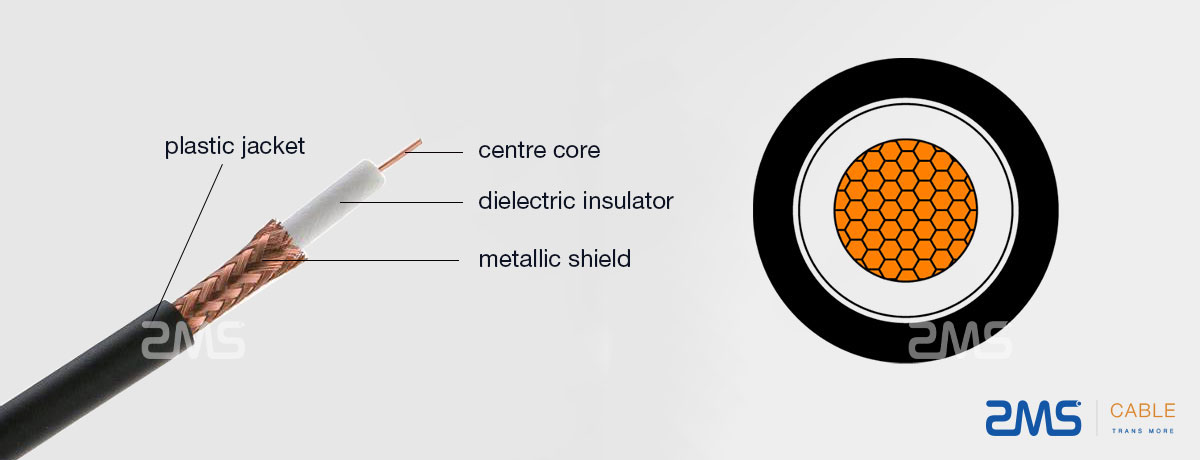
Structure of a coaxial cable
And coaxial cable is made up of four concentric elements. Materials and construction of each vary by application, frequency and installation conditions.
| Layer | Function | Common options |
| Central conductor | Carries the electrical signal | Copper or copper-plated steel (CCS), solid or stranded conductor depending on the model |
| Insulating (dielectric) | Separates the center conductor from the shield and helps define the characteristic impedance | PE plein, Expanded PE (mousse), PTFE for certain specific applications |
| Conductive shield | Reduces coupling of electromagnetic interference and outward radiation | Feuillard aluminium, metal braid (copper, aluminum or tinned copper), strapping suit + braided |
| Outer sheath | Protects the cable against mechanical stress and environmental attacks, including humidity and UV depending on the design | PVC, PE for certain outdoor installations, LSZH according to project requirements |
Characteristic impedance (75 Ω or 50 Oh) depends on the internal geometry of the cable, that is to say the diameter of the central conductor and the insulator, as well as the dielectric properties of the latter. Shielding, his, is chosen according to the electromagnetic environment and the frequency range.
Impedance : 75 ohms or 50 ohms ?
Characteristic impedance is one of the first data to check when choosing a coaxial cable. It must correspond to that of the connected equipment : a cable 75 ohms and a cable 50 ohms are not interchangeable. Impedance mismatch causes reflections and signal losses, all the more annoying as the frequency is high.
| coaxial cable 75 ohms | coaxial cable 50 ohms | |
| Current applications | Video, TV, satellite, some, video surveillance | Radio frequency, radiocommunication, instrumentation |
| Common models | RG-6, RG-11, RG-59 | RG-58, RG-213 |
| Special feature | Low attenuation, suitable for video distribution | Good compromise between attenuation and transmissible power |
The cable types presented below are classified according to this impedance.
Coaxial cable types available from ZMS Cable
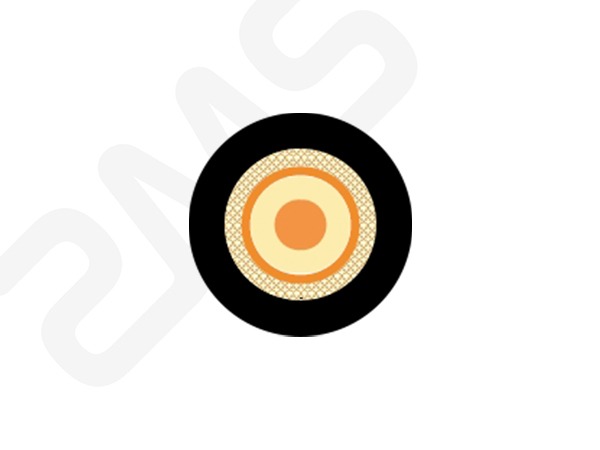
RG-6 coaxial cable
RG-6 is a coaxial cable 75 ohms, used for distribution of TV signals, satellite and CATV, as well as for certain video links. It differs from the RG-59 by a thicker construction, usually associated with increased shielding and lower attenuation.
Council of experts : Council of experts : for a satellite or long distance link, check the attenuation at the frequency used. If the cable feeds an LNB, prefer a copper conductor to copper-plated steel (CCS) to limit the voltage drop. For long distances, a larger diameter cable, like the RG-11, can be an interesting alternative thanks to its lower attenuation per unit length.
Characteristics of RG-6 coaxial cable
| Impedance | Central conductor | Insulating | Shielding | Outer sheath | Personalization |
| 75 Oh | Copper or copper-plated steel (CCS) | Expanded PE | Feuillard aluminium + braided | PVC I or (outdoor use) | Conductor and shield materials, sheath color, marking, packaging in reels |
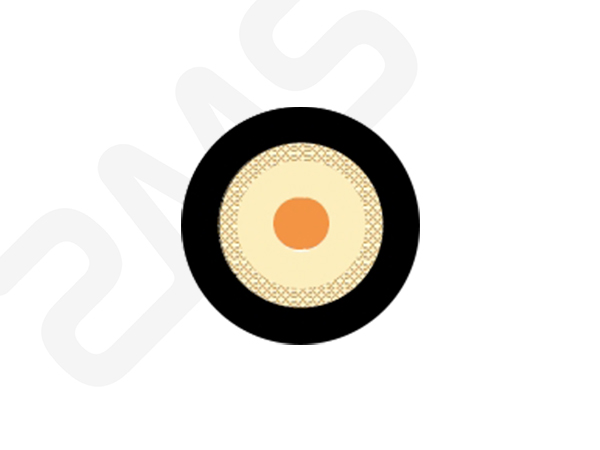
RG-59 coaxial cable
The RG-59 coaxial cable is a cable 75 ohms used for short distance video links, particularly in video surveillance (CCTV) and for certain analog video installations. Thinner and more flexible than RG-6, in return it presents a higher attenuation at high frequencies.
Council of experts : for a new video surveillance project, check video format (analog or HD over coaxial) and link distance. Beyond a few dozen meters, choose an RG-6.
Features of RG-59 coaxial cable
| Impedance | Central conductor | Insulating | Shielding | Outer sheath | Personalization |
| 75 Oh | Copper or copper-plated steel (CCS) | Full or expanded PE | Braided, ou feuillard aluminium + braided | PVC | Driver, shielding, sheath, marking, reels |
RG-11 coaxial cable
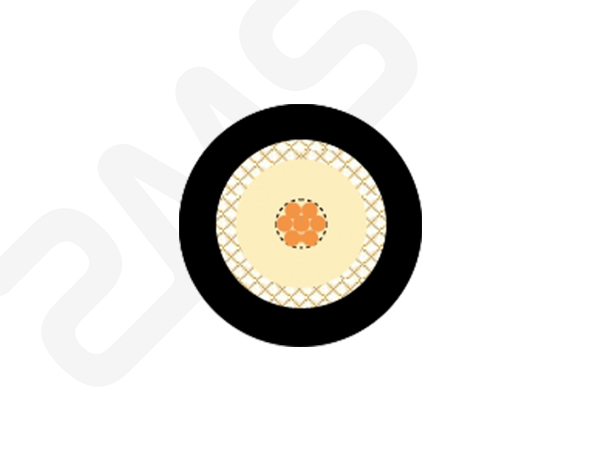
The RG-11 coaxial cable is a cable 75 ohms designed for long distance connections in TV distribution, satellite and CATV. Thicker than RG-6, it offers lower attenuation per unit length, which makes it possible to limit losses over long distances. Its size makes it more rigid and more difficult to install..
Council of experts : before choosing an RG-11, check allowable bend radius and connector compatibility, because its greater diameter often requires specific connectors. If RG-6 attenuation remains acceptable on your link, it will be easier to install.
Features of RG-11 coaxial cable
| Impedance | Central conductor | Insulating | Shielding | Outer sheath | Personalization |
| 75 Oh | Copper or copper-plated steel (CCS), plein | Expanded PE | Feuillard aluminium + braided | PVC I or (outdoor use) | Driver, shielding, sheath, marking, reels |
RG-58 coaxial cable
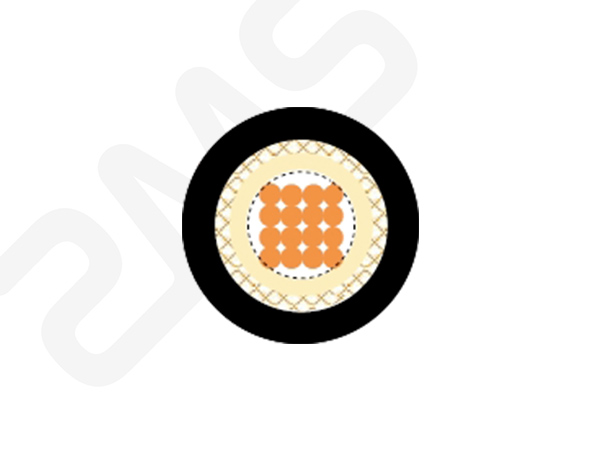
The RG-58 coaxial cable is a cable 50 ohms used for radio frequency links, radiocommunication and connection of measuring or instrumentation equipment. Flexible and space-saving, it is suitable for short to medium length connections. Its impedance of 50 Ω distinguishes it from video distribution cables (RG-6, RG-59), which are cables 75 ohms.
Council of experts : do not replace a cable 50 ohms through a cable 75 ohms (nor l'inverse) : impedance mismatch causes reflections and losses. For connections subject to repeated movements or bending, choose a stranded conductor.
Features of RG-58 coaxial cable
| Impedance | Central conductor | Insulating | Shielding | Outer sheath | Personalization |
| 50 Oh | Copper, full or stranded (possibly tinned) | PE plein | Copper braid (possibly tinned) | PVC | Driver, shielding, sheath, marking, reels |

RG-174 coaxial cable
The RG-174 coaxial cable is a cable 50 ohms very small diameter, used for short radio frequency links, patch cords and internal wiring of equipment. Thinner and more flexible than RG-58, it is easily installed in small spaces, but its attenuation is significantly higher : it is suitable for reduced lengths.
Council of experts : reserve RG-174 for short links and internal connections : beyond a few meters, attenuation becomes penalizing, especially at high frequencies, and an RG-58 or RG-213 is preferable. Also check the compatibility of the connectors, adapted to its small diameter.
Features of RG-174 coaxial cable
| Impedance | Central conductor | Insulating | Shielding | Outer sheath | Personalization |
| 50 Oh | Copper or copper-plated steel (CCS), multibrins | PE plein | Copper braid (possibly tinned) | PVC | Driver, shielding, sheath, marking, reels |

RG-213 coaxial cable
The RG-213 coaxial cable is a cable 50 ohms used for power radio frequency links, antenna feeders and radiocommunication installations. Thicker than RG-58, it offers lower attenuation and supports higher power, making it suitable for longer connections. Its size makes it less flexible..
Council of experts : for a long link or high power, RG-213 is preferable to RG-58, but check the bend radius and connector compatibility, adapted to its diameter. As with any cable 50 ohms, do not connect it to a system 75 ohms.
Features of RG-213 coaxial cable
| Impedance | Central conductor | Insulating | Shielding | Outer sheath | Personalization |
| 50 Oh | Stranded copper (possibly tinned) | PE plein | Copper braid | PVC I or (outdoor use) | Driver, shielding, sheath, marking, reels |
Which coaxial cable to choose depending on the application ?
The right coaxial cable depends on the application, the frequency and length of the link. The table below indicates the models most suitable for each use ; they must be validated according to the actual characteristics of your installation.
| Application | Recommended cable | Impedance | Selection criteria |
| Distribution TV and CATV | RG-6 ; RG-11 for certain long connections | 75 Oh | Frequency, length, mitigation |
| Satellite reception | RG-6, according to the required characteristics | 75 Oh | Frequency band, shielding, conductor resistance and voltage drop for LNB power supply |
| Video surveillance (CCTV) | RG-59 or RG-6 depending on video format and distance | 75 Oh | Video format (analog or HD over coaxial), distance, mitigation |
| Radiocommunication, antennas and instrumentation | RG-58 for certain RF links ; RG-213 if its characteristics are suitable for the application | 50 Oh | Frequency, admissible power, mitigation, connectors |
| Outdoor installation | Depending on cable construction and system | According to the system | UV resistance, humidity, temperature range, installation method |
| Installations in buildings in Europe | According to the specifications and the type of cable | According to the system | Applicable standard, CPR requirements, proof of conformity |
To choose, start with the system impedance, then check the attenuation at the frequency used over the planned link length, the required shielding level and installation conditions.
A doubt about the model ? Indicate the application, frequency and link length : we help you choose the right cable.
Custom coaxial cables ---- ZMS CABLE
As a manufacturer, ZMS adapts the construction of coaxial cables to the needs of distributors, importers, installers and project leaders. For volume orders, the following can be customized :
| Element | Customization options |
| Central conductor | Copper, copper-plated steel (CCS) or tinned copper ; full or stranded |
| Insulating | Solid PE or expanded PE |
| Shielding | Braided, feuillard aluminium + braided, multi-layer shielding |
| Outer sheath | Material (PVC, PE, LSZH), color |
| Marking | Personalized printing (marque, reference, footage) |
| Packaging | Coils, tourets, rollers |
When a tailor-made solution is useful
- Connection subject to a strong electromagnetic environment : reinforced shield
- Outdoor installation or in an aggressive atmosphere : adapted sheath (PE, LSZH)
- Powering equipment via coaxial cable : copper driver
To establish your quote, indicate the impedance, l’application, the frequency, the bond length and estimated quantity.
Frequently asked questions ---- coaxial cables
What is coaxial cable used for? ?
A coaxial cable transmits video and radio frequency signals while limiting interference thanks to its shielding. It is found in TV and satellite distribution, video surveillance, radio links and instrumentation.
What is the difference between RG-6 and RG-59 ?
These are two cables 75 ohms. RG-6 is thicker, with generally reinforced shielding and lower attenuation, what is suitable for TV connections, longer satellite and CATV. RG-59, thinner and more flexible, mainly used for short distance video links.
Braid alone or aluminum strip + braided : how to choose shielding ?
The braid offers good mechanical strength and high flexibility ; the aluminum strap ensures complete coverage, effective against high frequency interference. The combination of the two protects over a wider frequency range. The choice depends on the electromagnetic environment and installation constraints.
What information to provide to obtain a coaxial cable quote ?
Indicate the impedance, l’application, the frequency, bond length or total quantity, the installation environment and any standards. If the model is not defined, describe your equipment and your application : we help you choose the right construction.
Our professional services
By choosing high quality cables, you offer your teams and facilities a higher level of security — and this is precisely what ZMS services aim to guarantee.
ZMS designs and produces tailor-made cables according to your technical specifications, with customization of the marking, Colors and packaging. Our products can be adapted to meet international standards (GB, IEC, BS, NFC, ASTM, FROM, etc.) and the specific requirements of each project.
All cables are tested before shipment and comply with CE certifications, IEC and ISO. Detailed test reports can be provided upon request to ensure the reliability and safety of your installations.
ZMS cables are carefully packaged on wooden spools, corrugated cardboard boxes or metal drums. Ends are tightly sealed with plastic wrap or BOPP to prevent moisture. Exterior marking can be personalized with waterproof materials.
We offer flexible and fast logistics solutions to more than 130 pays :
- Maritime : 20ft or 40ft containers depending on volume.
- Land : Local or regional delivery.
- Air : Option available for rush orders.
We also provide all necessary export documents : commercial invoice, packing list, certificate of origin and customs documents.
Our engineers and advisors support you in choosing the cables best suited to your installations. We offer comprehensive consulting services, including technical assistance and project management, to ensure every step of your order is covered professionally.
ZMS offers two options for your electrical projects :
- Option A (led by ZMS) : Sending engineers and a supervision team to site to provide technical advice, installers and final tests. Travel expenses, accommodation, per diem and translation are to be expected.
- Option B (local subcontracting) : Collaboration with qualified local companies for installation, with technical training, On-site supervision and compliance verification provided by ZMS.
