
The report “Powering Toward 100 Percent Clean Power by 2035”, published by Evergreen Action and NRDC, explains how President Biden can build on the clean energy investments provided by the Inflation Reduction Act (IRA) and close remaining pollution gaps to meet its climate commitments. It suggests ways to achieve energy 100% clean from here 2035.
How Will Biden Achieve This Goal ?
To achieve this objective, it will be necessary to make a massive transition towards renewable energies.
This will reduce greenhouse gas emissions caused by power plants, which are the second source of global warming in the world.
It will also allow Americans to use clean electricity produced from renewable energy to power their electric cars., their heat pumps and other electronic devices.
To achieve the climate agenda he promised the Americans, the president must make significant progress this year in implementing the energy transition, particularly in the electricity sector, which is the largest source of greenhouse gas emissions in U.S. industry and key to decarbonizing the economy as a whole.
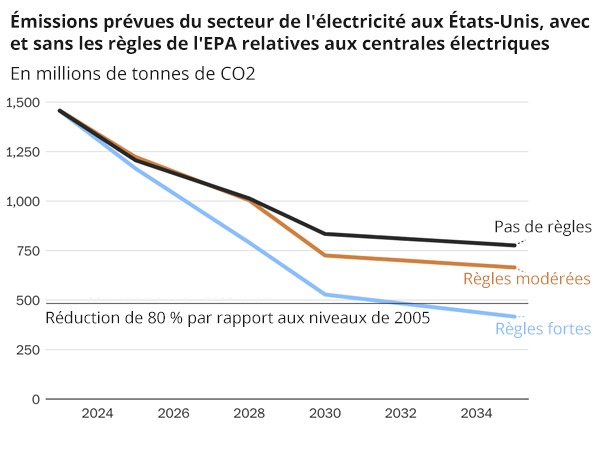
It is crucial to establish carbon pollution standards for existing and new power plants through the Environmental Protection Agency (EPA) to reduce greenhouse gas emissions.
The rule 111(b) will establish energy performance standards for new power plants using fossil gases, meaning that all currently proposed gas-fired power plants cannot be built unless they reduce their carbon emissions to a threshold specified by the EPA.
This rule will reduce greenhouse gas emissions by some 200 gas-fired power plants planned across the country.
The rule 111(d) will establish emissions guidance for existing power plants and require states to develop plans to reduce emissions from their existing coal and gas-fired power plants to meet EPA emissions limits.
This rule will help reduce greenhouse gas emissions by 25% of existing power plants in the United States.
If investments in the Inflation Reduction Act are combined with strict EPA regulations for power plants, the United States could achieve 76% clean electricity network here 2030, almost achieving the goal of 80%.
This will be in line with the objective of achieving 100% clean electricity from here 2035.
Development of Renewable Energy in the United States in 2022
After a two-year hiatus due to the COVID-19 pandemic and disruptions to energy markets caused by Russia's invasion of Crimea in February, the rapid transition to renewable energy has become the subject of concern in 2022.
Solar energy market share, large-scale wind and hydroelectric power continued to grow visibly on a daily basis : in 2022, 191 days have seen the market share of renewable energies exceed 20 %, i.e. more than three times the number of days recorded in 2019 (63 days).
This means renewable energy is quickly approaching equality with coal, with only 218 days exceeding 20 %, against 335 days in 2019.
This trend could continue for the foreseeable future : the US Energy Agency (EIA) predicts that two-thirds of the network capacity added in 2023 will be wind and solar energy, with 18 % additional from storage batteries.
During this time, the role of coal in the manufacturing industry electricity continues to decrease. Although rebounds could be observed last year due to the increase in natural gas prices and the resumption of economic activities in the United States, real electricity generation from coal has decreased by approximately 6 % in 2022 compared to 2021 and of 10 % compared to 2019.
The market share of coal in the electricity industry has not exceeded 20 % during the 7 month of 2022, which is similar to 2020, when pandemic lockdowns dramatically reduced electricity consumption.
This is an important figure because, avant 2020, coal had never seen a drop in market share for a month.
States Take Measures To Develop Clean Energy
People are replacing gas boilers and water heaters with electric cars (EV) energy efficient and electromagnetic cooktops.
Switching from fossil energy to a clean energy source, allowing us to decarbonize everything from the house to the electricity grid.
Large-scale decarbonization involves everything, from comprehensively reforming local building standards to ensuring that the electrical network can efficiently and reliably satisfy higher electricity demand.
It also means investing in job training so technicians are ready to install and maintain new clean energy technologies..
At the end of the day, it is necessary to continue to promote decarbonization measures at the federal and local levels.

The Minnesota House of Representatives passed a bill Thursday evening that will require Minnesota utilities to become entirely clean energy before 2040, ten years before the plans of Xcel Energy and Minnesota Power, the state's two largest retail utilities, to eliminate coal, natural gas and any other energy source emitting greenhouse gases responsible for global warming.
“FERC and States have a fundamental role to play in the transition to clean energy”, Ricketts said.. “And more and more states are committing to adopting clean electricity standards or accelerating their timelines in line with the transition that must occur.”
Currently, 15 states and regions, including Hawaii, California, the District of Columbia and Porto Rico, have established requirements to achieve 100% clean electricity.