
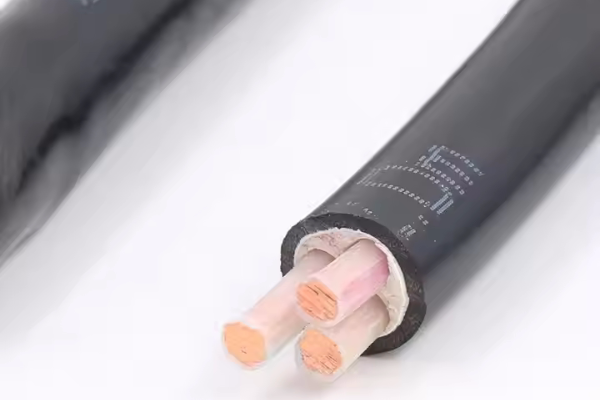
- Ready to use with pre-assembly
- Fire and oxidation resistant
- Industrial resistance to wear
- ZMS Cable offers a fully customizable service | Personalization on request (Color/length/number of conductors/packaging)
Product description
The VGV cable is a high performance cable designed for domestic and industrial installations. Not only is it suitable for domestic devices, But it offers easy installation thanks to its flexible design. It is also humidity resistant, which makes it ideal for use in wet rooms. Furthermore, VGV cables are robust, adapted to underground installation and capable of resisting difficult external conditions. Its excellent protection against electromagnetic interference and its stable performance in terms of power transmission guarantee a reliable and safe power supply for a wide range of applications.
Construction
| Construction | Features |
| Driver | – Material : Copper receipt (IEC 60228 Class 2) |
| – Structure : Twisted multi-brins (typical 7/19/37 strands) | |
| – Surface finishing : Naked or tinned copper (optional) | |
| Insulation layer | – Material : PVC Type TI1 (standard model) |
| – Thickness : 0,6 mm (nominal section ≤ 2,5 mm²) | |
| 0,7 mm (nominal section 4-6 mm²) | |
| Sheath layer | – Material : PVC Type TM1 (standard model) |
| – Thickness : 1,0 mm (Unique driver cable) | |
| 1,2 mm (multi -evil cable) |
VGV cable application
VGV cable is used in various fields :
- Domestic and industrial electrical installations
- Food networks for commercial buildings
- Sectors requiring strong protection against electric disturbances
- Infrastructure requiring stable and lasting transmission of electricity
- Flexible cables : Perfect for household appliances.
- Cables for wetlands : Ideal for water rooms, humidity resistant.
- Cables for buried installations : Robust, adapted.
Standard
IEC 60227-1; IEC 60228 Class 1/2; IEC 60811; IEC 60332-1; NF C32-207/A1; CE; RoHS 3 (EU 2015/863)
Properties
Mechanical performance (IEC 60811-1)
| Test | Normative requirement |
| Tensile strength | ≥12,5 N/mm² (sheath) |
| Lengthening to rupture | ≥150 % (sheath) |
| Flexion sustainability | 20d × curvature radius 5000 cycles sans fissures |
Environmental adaptability
| Environmental condition | Performance |
| High temperature aging | After 168 H at 80 ° C, Traction resistance should be ≥80 % (IEC 60811-2-1) |
| Low -temperature flexion | After 4 H to -15 ° C, Pass the curvature test to 15D (IEC 60811-1-4) |
| Oil resistance | After immersion in MRI oil 903 at 40 ° C during 24 h, Gaine volume expansion rate <20 % (IEC 60811-2-1) |
Electrical safety settings
| Setting | Normative requirement |
| Isolation resistance | ≥0,0367 MΩ·km (70°C) |
| Voltage resistance test | 3 kV DC / 5 min (type test) |
| Continuity of the earth | Resistance ≤5 Ω (length of 100 m) |
Performances EMC (Unlissed)
| Frequency beach | Interference influence (dBμV/m) |
| 30 MHz | ≤40 (crest value) |
| 100 MHz | ≤35 (crest value) |
Technical data
| Number of drivers | Nominal section (mm²) | Approximate weight (kg/km) | Maximum outside diameter [mm] | Nominal current eligible in open air [A] | Voltage drop, single -phase [In/a.km] |
| 2 | 1.5 | 130 | 10.5 | 20 | 23.0 |
| 2 | 2.5 | 170 | 12.0 | 26 | 14.0 |
| 3 | 1.5 | 137 | 11.0 | 20 | 23.0 |
| 3 | 2.5 | 214 | 12.5 | 26 | 14.0 |
| 4 | 1.5 | 169 | 12.0 | 20 | 23.0 |
| 4 | 2.5 | 261 | 13.5 | 26 | 14.0 |
| 5 | 1.5 | 211 | 12.5 | 20 | 23.0 |
| 5 | 2.5 | 314 | 14.5 | 26 | 14.0 |
Special model settings
1. Flame delayer type (FR-VGV)
| Setting | Technical specification |
| Flame delay classification | Compliant with IEC 60332-1-2 (Individual vertical combustion, carbonization height ≤ 2,5 m) |
| Smoke density | Transmittance ≥ 60 % (IEC 61034-2) |
| Liberation of halogenated gas | pH ≥ 4,3, conductivity ≤ 10 µS/mm (IEC 60754-2) |
2. Cold resistant type (ARCTIC-VGV)
| Setting | Technical specification |
| Low -temperature performance | Flexion test at -40 ° C without cracks (IEC 60811-1-4) |
| Sheath material | Cold resistant PVC (Vitreous transition temperature ≤ -30 ° C) |
Comparison (VGV vs VVF vs H05V-K)
| Features | VGV (300/500V) | VVF (300/500V) | H05V-K (European standard) |
| Driver type | Class 2 (multibrins) | Class 1 (plein) | Class 5 (very fine strands) |
| Service temperature | +70°C (permanent) | +70°C | +70°C |
| Radius of curvature | 6×D (fixe) | 5×D | 4×D |
| Oil resistance | Average (Compliant with IEC 60811) | Basic | Haute (in accordance with 50363-3) |
| Applications | Wiring industrial control panels | Fixed installation in buildings | Flexible connection inside the equipment |
Advantages of the VGV cable
- Reinforced security : High quality insulation guaranteeing short-circuits protection.
- Performance optimale : Stable current transmission, reducing energy losses.
- Exceptional sustainability : Resistant materials ensuring a long service life.
- Personalization : Available in different sections and lengths thanks to the services of ZMS Cable.
- Versatility : Adapted to various uses, From walls to lighting.
- Security : Their PVC insulation effectively protects from short circuits and electric shocks.
- Sustainability : Designed to withstand wear.
- Ease of installation : Their flexibility allows easy passage within the walls.
Lorem very carrots, Minneapolis undergraduate developer. To the movie region, mourning or ullamcorper real estate, Pulvinar protein lion.