
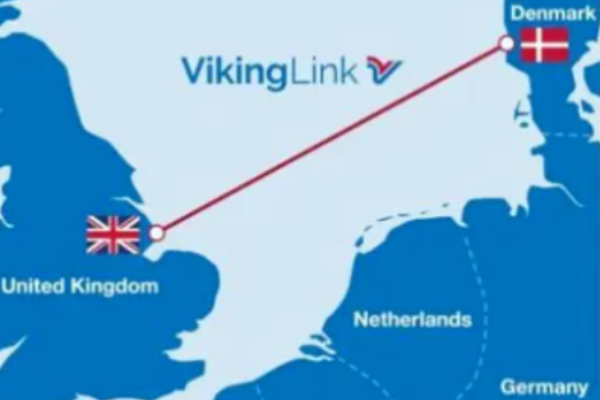
The world's longest terrestrial submarine cable has been completed. The line is located between Lincolnshire, in the United Kingdom, and Denmark, for the transport of renewable energy.
Long 765 kilometers (475 miles), it crosses land and sea and cost a total of 1,7 billion euros. Construction began in 2020 and from here 2023, the line will be built and could provide clean electricity to 2 million homes.
This electricity project is also an important step towards greening the UK. Mike Elmer, director of Grid, said the Viking Link cable project was playing a key role in making the UK carbon neutral by providing cleaner, greener electricity.
Katie Jackson, de National Grid Ventures, declared : “Viking Link is a great example of an energy project that will provide safer and cheaper electricity to regions. Connecting UK and Denmark green energy networks plays important role in improving security and reducing costs”.
The site web de Viking Link indicates that during the first year of use, it is expected to reduce carbon emissions by approximately 600 000 tons, or the equivalent of carbon dioxide emitted by 280 000 cars.
History of Submarine Cable
With the rapid development of the industry in the United Kingdom, demand for electricity has increased dramatically. To meet energy needs, UK began exploring submarine cable technology.
Submarine cables break away from traditional land cables affected by terrain factors. They enable the transoceanic transmission of electricity and connect the UK and European power grids.
In 2000, submarine cables have experienced overcapacity due to a lack of construction demand. The submarine cable market then collapsed.
Between 2011 et 2015, several submarine cable projects have been undertaken in Asia. These include South East Asia Japan Cable (SJC) and Asia Submarine Cable (ASE).
With the development of fiber optic cables and cloud service technology. Demand for submarine cables from cloud service providers such as Amazon, Facebook and Google are growing rapidly. Significant investments in submarine cable projects to ensure high-bandwidth, low-latency communications networks.
Premiers Pprojects of Cable Sous-marin
The world's first land-based submarine cable was laid in the mid-19th century. Crossing the Channel, it linked the United Kingdom to continental Europe. The cable measured approximately 25 miles long and was used for transmitting information.

Following the success of this project, Planning has begun for a land-based submarine cable project linking Ireland to Newfoundland across the Atlantic Ocean.
Project of Cable SAtlantic submarine
Soon after, the Atlantic Telegraph Company completed the first crossing submarine cable the Atlantic Ocean, with a length of 2 500 in which. connecting Ireland and Newfoundland.
It was a bold and risky undertaking. Once the terrestrial submarine cable is completed and laid, he caused a sensation all over the world.
Of course, the project experienced a number of failures. The first time, two laying ships sailed from opposite ends to the middle of the Atlantic Ocean to splice the land-based submarine cable after the rendezvous. But during the journey, the cable was torn.
A second attempt was made by laying the mid-Atlantic cable towards both ends. But under the influence of the storm, the skin of the cable has become badly worn and has come loose. This resulted in the loss of signals in the cable. The second attempt ended in failure.
A third trip was undertaken in July 1858. The big attempt is finally made. Connecting the American continent to Europe.
Laying and installation of submarine cable
Laying submarine cables requires the use of a modified laying vessel that can load the cable and lay it on the water floor. Depending on the state of the sea and the activity of the seabed, environ 150 kilometers can be laid in a day.
One end is first connected to a shore connection station. The cable is then routed to the seabed via the laying vessel. The cable is not simply laying on the seabed when it enters it. On the contrary, tools are used to dig trenches in the seabed, in which the cables are buried. This helps hide the cable and further protect it.
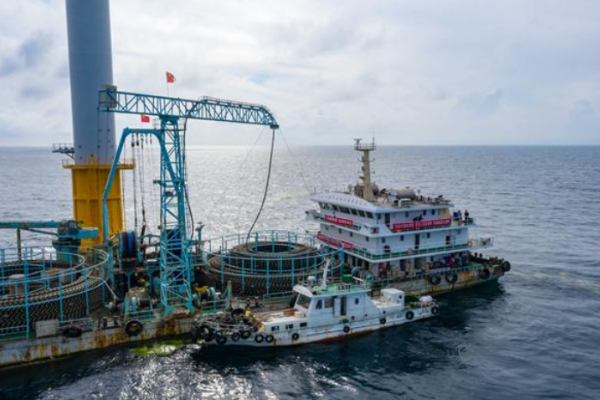
Of course, many preparations are necessary before laying the cable. This includes route selection, detecting the state of the seabed, cable design and manufacturing, and many other aspects of preparation.
Impact of the Submarine Cable Project Land on the British Energy Sector
The UK is expected to reach net zero emissions by 2050. The energy transition will be essential in this process. Clean energy will become the main source of electricity supply.
With the establishment of net zero emissions targets, UK government increases investment and support for clean energy. The development of clean energy not only reduces dependence on traditional fossil fuels. But also to reduce carbon emissions and promote sustainable development.
Thanks to submarine cables, it is possible to connect the UK to the clean energy networks of other European countries. The establishment of these cross-border connections will provide more opportunities and markets for the development and use of renewable energy, and promote international cooperation and the exchange of clean energy.
The UK is expected to reach net zero emissions by 2050. The energy transition is essential in this process. Clean energy will become the main source of electricity.
There is also a close relationship between offshore wind projects and submarine cables. Offshore wind power produces electricity from the force of the wind, which must be transmitted to the earth. Submarine cables play an essential role in transmitting electricity produced by offshore wind to land.
The development and exploitation of offshore wind energy provides a reliable basis for energy transportation. At the same time, offshore wind energy, as a renewable energy source. Can also promote the development of green energy and the transformation of traditional energy sources.