
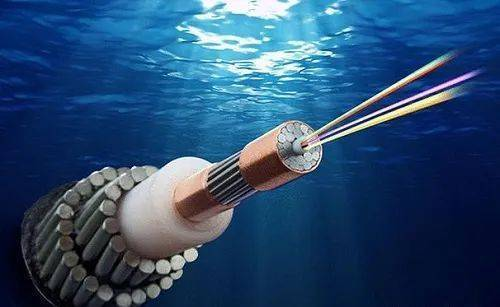
Submarine cables are cables wrapped in insulating material. Submarine cables are laid on the seabed and are used for the transmission of electrical power and communications over long distances. Compared to land-based cables, submarine cables differ in their applications and installation methods. But they essentially play the same role. Submarine cables strengthen ties between countries and facilitate the development of the global integration process. At the same time, submarine cables also constitute an innovative form of transmission of elders.
Development history
In 1839, William Cooke and Charles Wheatstone develop the concept of an underwater line and carry out simple experiments. From, more and more scientists have studied submarine cables and formulated perspectives. More and more, the idea of underwater lines crossing oceans is seen as the way of the future.
In 1850, the world's first submarine cable was successfully laid, reliant Calais, In France, and Dover, in England. Since then, the exploration and development of submarine cables have received increased attention and research. At first, submarine cables were copper communications cables, which had a short lifespan, unique function and slow signal transmission. In the years 1980, the development of fiber optic cables has begun.
In 1988, optical fiber TAT-8 was first used in a transatlantic telephone cable. Modern submarine cables use optical fiber as a material for transmitting telephone and Internet signals, as well as electrical energy.
Production of submarine cables
Fabrication
In the manufacture of submarine fiber optic cables, the fibers are first coated in a gelatinous compound that protects the cable from damage, even if it comes into contact with sea water. The fiber optic cable must then be wrapped in a steel tube to prevent water pressure from damaging it.
Ensuite, The cable is wrapped in high overall strength steel wire and sheathed in copper tube, which is then covered with a protective layer of polyethylene. Near the coasts of the continental shelf, Submarine cables are often laid with lightweight cables that have stronger steel wires and are covered with a bituminous coating to protect them from corrosion from seawater.
The structure of submarine fiber optic cables is as follows :
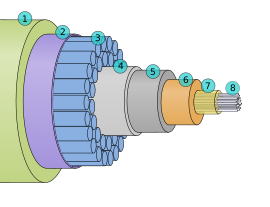
- polyethylene outer skin
- layer of polyester resin or bitumen
- layer of steel wires
- aluminum waterproof layer
- polycarbonate layer
- copper or aluminum tube
- paraffin or alkane layer
- fiber optic bundle
Core
The core of the submarine cable is made of high purity optical fibers, fine as a hair, which guide light along the fiber path by internal reflection. Submarine cables must be able to withstand enormous pressures at 8 kilometers underwater, which is equivalent to the weight of an elephant under a person's thumb. Submarine cables are designed, manufactured, installed, operated and maintained through the application of complex technologies.In addition, Environmental sensing and physical study of the marine environment also require strong technical support, so that submarine cable engineering is recognized by countries around the world as a complex and difficult large-scale project.
Currently, there are not many countries in the world that can manufacture submarine cables, mainly Norway, Denmark, Japan, Canada, the United States, The United Kingdom, France, Italy and other countries, in addition to the manufacturing of these countries which also supply the installation technology.
Distribution of cables at the bottom of the sea
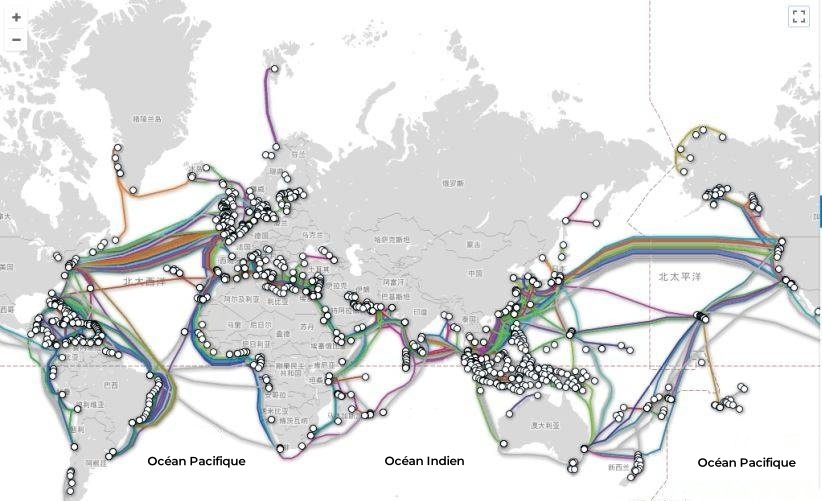
Data can be stored in the “cloud”, but they are sent and received in the depths of the sea.
Submarine cables, hidden under the waves, represent approximately 95 % international data transmissions.
It is estimated that almost 1,4 million kilometers of submarine cables are used worldwide. They guarantee the proper use of electrical energy and the unhindered circulation of electronic mail, content and phone calls. Submarine cables connect huge data centers and facilitate communication exchanges, resource integration, global cooperation and development. Submarine cables contribute significantly to the global integration process.
There is currently 552 active or planned submarine cables around the world.
Submarine cable applications
Submarine cables have a wide range of applications as electrical appliances.
Exploration of seabed resources
The sea is a treasure trove of resources. The process of exploring and exploring the seabed requires the use of various electronic devices and the transmission of information from sensors. Underwater cables can be used to transmit information to help scientists get the data they need.
Submarine cables are a major component of international long-distance telecommunications networks. Compared to conventional radio cables, submarine cables enable long-distance voice communication. Undersea cables are safer and less likely to be intercepted. With the development of digital technology, speed and bandwidth of information requests increases. The transmission speed and capacity of submarine cables are also greatly improved
Commerce international
Submarine cables also play an important role in international trade.
Trade between different parts of the world requires rapid and reliable transmission of information. Submarine cables can provide an efficient and stable communications network for international trade.
With the constant advancement of technology and increasing demand, submarine cables are gradually playing an increasingly important role in the construction of infrastructure in the fields of ocean exploration, communications networks and international trade.
You want to know more about submarine cables ? Stay tuned and we will continue to tell you about submarine cables in the next article.