
In the purchase of electrical cables, it is common to make decisions based on intuition or the appearance of the product. Yet, the manufacture of a cable is the result of precise engineering, combining materials science and complex industrial processes. Certain ideas that we think are obvious often turn out to be far removed from the technical reality of the sector.
In this guide, we will clarify some common misconceptions and explain the risks they can cause in a project. The objective is to help you better assess the quality of an electrical cable, to make a more precise choice of cable and avoid costly errors, to become a more informed buyer.
Six Common Misconceptions and the Technical Truth About Cable Manufacturing
Mistake #1 : “The color of the insulation and the sheath is only a visual criterion ?”
It is common to think that the color of a cable only has an aesthetic role or simply serves to differentiate the conductors.. Many imagine that we can freely choose red, blue or yellow without impact on performance.
In reality, the color constitutes both an identification code and an indicator of cable quality.
Direct link with material performance
Coloring comes from pigments (ou “masterbatch”) added to the base material. Their quality and dosage influence the thermal resistance and aging of the material. Low-end pigment becomes a weak point in the cable.
A indicator of the level of control of the process
To guarantee a reliable result, the pigments must be perfectly dispersed in the material. Uneven dispersion not only leads to color variations, but also differences in mechanical and electrical properties — which can create areas of weakness in the insulation.
A normative safety element, not a free choice
The color complies with standards of cable color strict (cable color code), defined by international standards to ensure the safety of electrical installations.
For example : yellow/green is exclusively reserved for the earth conductor. Incorrect color may cause wiring error and lead to serious accidents.
Mistake #2 : “Rigid or flexible copper, it's the same as long as the section is identical ?”
We often hear that the conduction capacity depends only on the section of the copper conductor and that the rigidity or flexibility of the cable does not matter.. Some even think that a flexible cable is always more practical.
In reality, the difference rigid vs. flexible corresponds above all to the intended use of the cable.
Rigid cable : Designed for fixed installations
The rigid cable (solid conductor) offers good mechanical resistance and generally lower cost. On the other hand, its flexibility is limited.
Ideal for fixed and immobile installations, such as building wiring or household circuits.
Flexible cable : for mobile and flexible applications
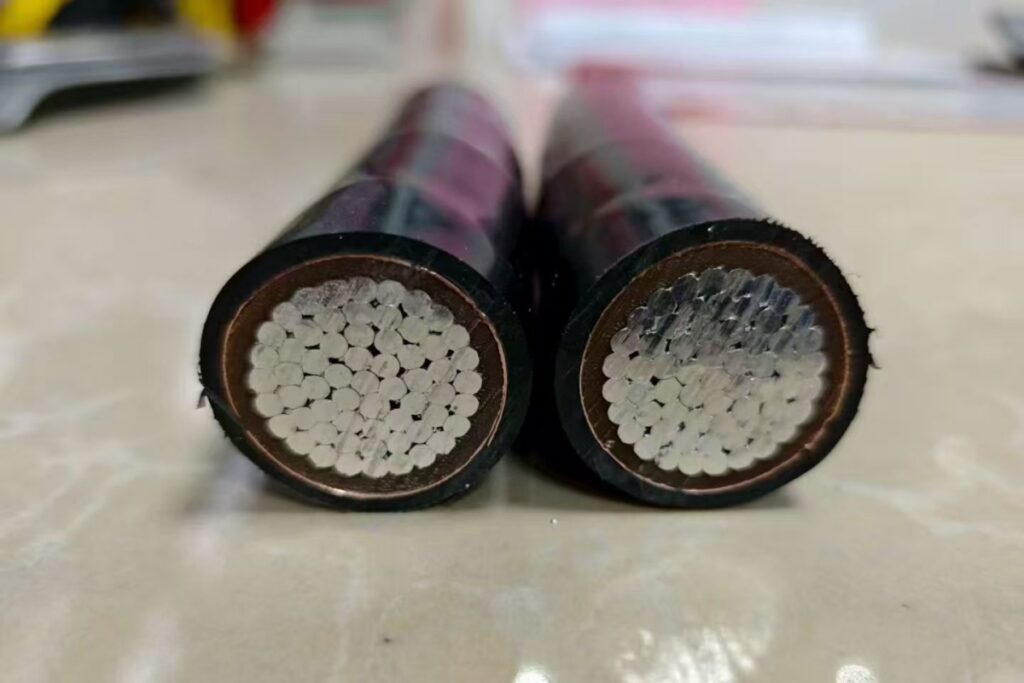
The flexible cable is made up of many twisted copper strands.
It provides exceptional cable flexibility and high resistance to fatigue from repeated movements.
Recommended for moving equipment : machine power supply, portable tools, robots, Shaft chains, etc.
Bad choice : risk of premature failure due to fatigue if a rigid cable is used in a mobile environment.
Definitive manufacturing know-how
For a reliable flexible cable, quality depends on precise technical parameters : no twist, tension control, regularity of stranding. Insufficient manufacturing can result in internal twisting, deformation or micro-cracks of the conductor.
Mistake #3 : “The insulation and sheath are both PVC, therefore interchangeable ?”
We often hear : “The internal insulation and the external sheath are both PVC. Since the matter is the same, why not use the same type of PVC to simplify production or reduce costs ? »
This is an extremely dangerous idea. The answer is no, they are never interchangeable.
Even if we talk about PVC (polyvinyl chloride) in both cases, the PVC intended for insulation and that used for the sheath are formulated in a completely different way. Their roles have nothing in common, just like the steel used to make a spring has nothing to do with that used to build a bridge.
Here are the key differences :
| Criteria | PVC d’isolation | Chicken PVC | Why they are not interchangeable |
| Main role | Guarantee reliable electrical insulation | Ensure mechanical and environmental protection | Two opposing missions : one protects the current, the other protects the cable. |
| Electrical performance | Very high requirements : high insulation resistance, voltage resistance, low dielectric losses | Low requirements : the sheath does not have an internal insulation role | ⚠ If the sheath is used as insulation → risk of perforation, court-circuit, current leak. |
| Mechanical resistance | Necessary flexibility but limited requirements for abrasion and tensile strength | Very high requirements : abrasion resistance, to shocks, to crush | ⚠ If the insulation is used as a sheath → rapid wear, fissures, loss of protection. |
| Weather resistance | Moderate | Very high : UV, heat, cold, humidity, ozone, aging | ⚠ Outdoors, an insulating PVC used as a sheath will harden, will crack and deteriorate quickly. |
| Material formulation | Additives geared towards electrical purity and dielectric stability | Additives dedicated to mechanical and climatic resistance : charges, plastifiants, anti-UV | Formulation differences = performance differences by design. |
Therefore, strict compliance with the principle “one material for a specific use” constitutes an essential red line in the manufacture of cables. It is also an essential criterion for evaluating the seriousness and level of professionalism of a manufacturer..
Mistake #4 : “A thicker jacket ensures a safer, more durable cable ?”
For the sake of cable protection and durability, many think that a thicker sheath is necessarily better.
In reality, Cable jacket thickness is a balancing act : thicker does not mean safer, nor more efficient.
A balance defined by standards, not an arbitrary choice
International and national standards set a minimum thickness to ensure the protection of the cable against mechanical attack.
But there is also a maximum limit, because a sheath that is too thick increases the diameter and weight of the cable, reduces its flexibility and complicates heat dissipation – which can harm the safety and performance of the installation.
Sheath uniformity : the true criterion of quality
The essential criterion is not the thickness itself, but its regularity throughout the cable.
- Too thin in places = risk of perforation and insulation fault.
- Too thick for others = waste of material and loss of performance.
High precision extrusion is essential to guarantee this uniformity.
The material remains the #1 performance factor
Abrasion resistance, oils, UV, in heat or cold : these properties come first from the formulation of the material, not of its thickness. Thickness only complements a good compound – it cannot compensate for poor quality material.
Things to keep in mind for the buyer
In the purchase of electrical cables, believing that “thicker = better” is one of the cable purchasing mistakes the most widespread. A good cable buying guide should remind us that the performance of a sheath depends first and foremost :
- good material,
- of process quality,
- then the thickness conforming to standards.
Mistake #5 : “Are filler materials inside the cable really necessary ?”
Many people view filler materials as simply “filling the gaps” between conductors., thinking they are optional or interchangeable.
In reality, the filling constitutes the internal structure of the cable, essential for its overall stability and security.
The filling : the internal framework of the cable
It guarantees the roundness and stability of the cable after assembling the conductors.
This allows the jacket to fit the cable evenly, avoids deformation, twists or irregularities during installation and improves mechanical life.
Essential technical functions in specialized cables
Depending on the cable type, filling can play a much more advanced role than just maintaining shape :
- Moisture barrier : threads or gel blocking the penetration of water (waterproof filling).
- Flame retardant system component : contributes to the overall performance of the cable in the event of a fire.
The choice of material is not interchangeable
Changing the padding just to “take up space” is a serious mistake.
The right material must be compatible with use of the cable : mechanical properties, thermal, flame retardant, or anti-humidity.
The risks if the filling is poorly chosen or of poor quality
- Non-round cable → difficult to insert into technical conduits and ducts.
- Breakdown of the consistency of the anti-fire system → rapid spread of flames.
- Absorption of humidity → reduction in insulation and risk of electrical faults.
Mistake #6 : “A cable with a layer of shielding is enough, no matter the density of the braid ?”
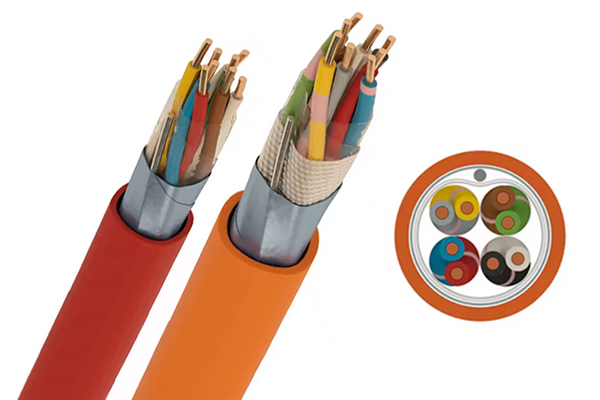
A common misconception is that the presence of a cable shield — usually a copper braid — is sufficient to protect against interference., and that the density of the braiding has little importance.
In reality, the effectiveness of shielding is directly linked to its coverage rate, a measurable and determining criterion.
Shielding performance is based on coverage rate
The level of protection against electrical interference and electromagnetic disturbances (EMI) depends on the percentage of surface actually covered by the braid.
Effective shielding typically displays ≥ 80%–90% coverage.
Every percentage lost increases the risk of disruption, signal losses or transmission errors, particularly in sensitive industrial or electronic environments.
High density = cost and know-how that shows
A denser copper braid requires more metal wires and a longer braiding time.
This is why shielding is a real indicator of the level of manufacturing quality : a cheaper cable is often one where the shielding density has been reduced.
The consequences of undersized armor
Less stable signal, more frequent interference
Risk of malfunction of connected equipment
Increased error rate in data transmission (errors, losses, parasites)
For the B2B buyer
In the purchase of electrical cables, Neglecting shield density is one of the most common cable purchasing mistakes. A good cable buying guide should remind : the presence of shielding is not enough — it is its measured effectiveness that counts.
Conclusion – Good Cable is in the Details
The reliability of a cable is not based on a single criterion, but on a number of technical details : materials, structure, sheath thickness, shielding, filling, intended application and compliance with standards. Each design choice is designed to meet a specific use — and that’s where quality comes into play.
A smart buyer doesn't just compare price. It evaluates the quality of design, sustainability, safety and life cycle cost. Understanding these details allows you to go beyond a “price/meter” comparison to adopt a professional and sustainable approach..
At ZMS Cable, we apply this vision of excellence at every stage. Our cables are built to last, with certified materials, strict quality control and rigorous compliance with international standards(IEC, BS, IN, NF etc.).
We also offer custom cables, adapted to your technical requirements (sections, materials, shields, norms, usage environment), to guarantee you a solution perfectly aligned with the needs of your project.
A good choice starts with a good partner — our mission is to provide you with reliable cables, safe, durable and optimized for your applications.