
- PV grounding cable is mainly used for electrical grounding protection of PV system.
- It can effectively prevent electrical accidents such as ground faults, leaks and electric shocks.
- It also helps prevent problems such as electromagnetic interference and lightning.
- Grounding is very important to guarantee the safety of photovoltaic installations.
- It is an essential and important element of a photovoltaic installation.
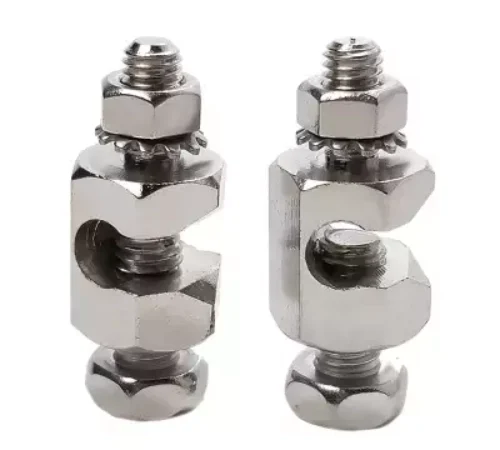
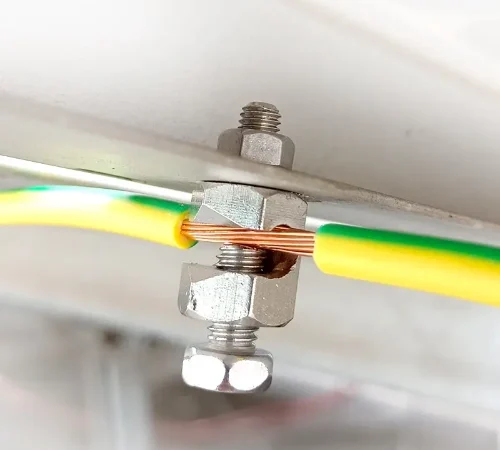
Grounding clips for solar PV
ZMS offers customized service for PV grounding clips. Here you will find all the product models you need. If you need grounding clips for PV, you can contact us.
Solar earth cable
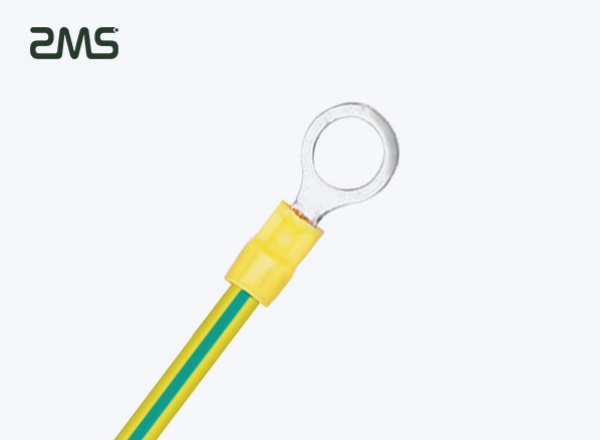
Product Name : Solar panel grounding cable
Model : Solar panel grounding cable
Marque : ZMS
Origin : Chine
Structure
Conductive material : Copper / Twisted tinned copper
Driver : single-core
Sheath : PVC
Insulating material : High quality PVC, customizable, abrasion resistant, waterproof, resistant to oil and chemical corrosion, etc.
Tension nominale : AC 1kV DC 1,5kV
Isolation : Isolation XLPE
Protective sheath : LSOH
Operating temperature : -40 has 125 °C
Minimum ambient temperature : Installation fixe -40 °C
Installation mobile -15 °C
Cable laying temperature : Not less than 0 °C
Radius of curvature : The radius of curvature must be at least 6 times the diameter of the cable
Allowed radius of curvature, cable diameter (D) less than or equal to 16 mm, must be at least 4D, greater than 16 mm, must be at least 6D
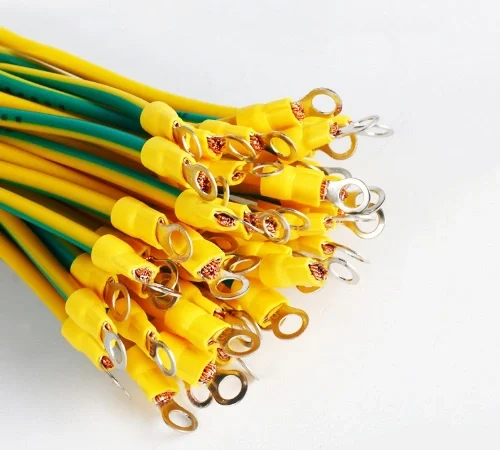
Material : Yellow-green ground wire BVR (0,75 mm2, 1 mm2, 1,5 mm2, 2,5 mm2, 4 mm2, 6 mm2, 8 mm2, 10 mm2, 16 mm2, 25 mm2, other customizable sizes)
Color : Two-tone yellow-green thread (other customizable colors)
Ends : Pure in pure cover M4/M6/M8 (other possible hole diameters)
Specifications : 1,5 mm2, 2,5 mm2, 4 mm2, 6 mm2, 10 mm2, 16 mm2, 25 mm2, 35 mm2, 50 mm2, 70 mm2, lengths can be cut as desired : common sizes are 50 mm, 100 mm, 120 mm, 150 mm, 180 mm, 200 mm
Application : Flexible connection for photovoltaic panels, electrical appliances, switching devices, electric ovens, batteries, etc.
Production : Manufactured by companies compliant with GB9330-88
Performances techniques : This product is designed in accordance with IEC227 standards, IEC1034, IEC332
Technical parameters : Implementation standard : JB/T8734.2-2012
Performance requirements :
① Class A or B in bundle, (carbonization height) : ≤2,5 m
② Non-inflammable (unburned distance) : ≥50 mm
③ Smoke density (transmittance) ≥60%
④ Tenure and HCL ≤0.5 mg/g
Grounding standards for photovoltaic modules
Specifications for grounding photovoltaic components include several aspects :
The need for grounding : Grounding is essential to guarantee the safety of people and the proper functioning of equipment. In photovoltaic systems, ground fault can affect the efficiency of electricity generation and increase the risk of current leakage, which poses a safety hazard.
Related standards
International standards : IEC standard 61730 specifies safety requirements and testing procedures for photovoltaic components, including grounding resistance test requirements ; to UL standards 1703 also sets out requirements for grounding of photovoltaic components.
Consequences of poor grounding : Faulty grounding can cause current leakage, security risks, electrical corrosion, etc., which reduces the efficiency of electricity generation and shortens the lifespan of components.
Measures for correct grounding :
Choosing high-quality grounding devices, with an earthing resistance less than 10 ohms.
Connect the metal chassis of the components to the grounding line to prevent current leakage.
The grounding conductor may be copper, alloy, complies with electrical specifications and construction standards, codes and regulations applicable to the place of installation.
Grounding hardware includes ground screws, flat washers, star washers and grounding cables, all made of stainless steel.
Ground connection must be carried out by qualified electricians, using properly sized grounding cables to connect component frames, all wire connection points must be solid.
Grounding between components : Adjacent grounding holes on component frames can be connected to provide secure grounding between components.
Grounding marking : Component grounding holes are marked for easy identification and maintenance (according to the IEC 61730-1).
These measures help ensure safety, the effectiveness and conformity of the grounding of photovoltaic components.
Choosing the right photovoltaic grounding cable
Different models of grounding cables have their own specific characteristics and application situations. For specific grounding cable parameters and application, the choice must be made according to real needs and the environment of use.
When choosing an equal potential grounding cable, it is necessary to take into account factors such as the nominal section of the cable, the material of the insulation, the number of conductors and the choice of material, to ensure good grounding efficiency. When testing grounding resistance, It is possible to reduce the grounding resistance during testing by adding a grounding agent, by drilling deeper or lightly burning the surface, to ensure that it meets applicable national and local standards. When installing equal potential grounding cables for photovoltaic systems, it is important to take into account the actual conditions of the power plant, to carry out on-site testing and choose the appropriate material and processing details to ensure the smooth operation of the power plant.
How to choose the thickness of the grounding cable
The choice of grounding cable should be determined based on the capacity of the photovoltaic module and the length of the cable.
In general, with the increase in the capacity of photovoltaic module and cable length, the thickness of the grounding cable should also increase to ensure sufficient current transfer and safety performance.
The conductor diameter of photovoltaic grounding cables is mainly 6 mm, 8 mm, 10 mm, etc., with various specifications, while their cross section is generally 35 mm² ou 50 mm². The larger the diameter of the conductor, the lower the resistance and the higher the lightning resistance capacity.
The thickness of the grounding cable is directly related to the safety and stability of the photovoltaic system.
| Possible scenarios | 1 | 2 | 3 | 4 |
| Capacity of PV modules(KW) | 1-5 | 5-10 | 10-20 | ≥20 |
| Cable length(m) | ≤20 | 20-50 | 50-100 | ≥100 |
| Recommended ground cable size(mm²) | 2.5 mm² | 4 mm² | 6 mm² | 10 mm² |
It should be noted that the above recommendations are for guidance only and the actual selection should be based on the specific conditions of the photovoltaic system, as well as local standards and regulations regarding electrical safety.
ZMS Product Description
High quality of products. ZMS strictly controls production standards, keeps margins of error within an acceptable range. Cables are manufactured with precision, with a smooth surface and no burrs.
Selected materials. Rigorous selection of materials, the raw materials are carefully sorted and each time selected on site, controlled from the source and meticulously crafted.
Personalized support, high volume discount. ZMS offers a customization service. Ici, you can find all the product models you need. Before ordering, please provide specific dimensions so we can quote (cross section required, length, lug hole diameter, protection on terminal crimping points, need heat shrink tubing or two-color heat shrink tubing on both ends).
Advantages of packaging
The loading tray is made of distillation wood, economical and environmentally friendly.
Reasonable layout maximizes space utilization and saves costs.
Each layer is covered with a wooden lid, which helps prevent extrusion.
The inside and outside of the packaging are wrapped with moisture-proof PE film, which can achieve good moisture-proof effect.
Additional information
This conductor is halogen-free (no flame or spread of fire), with low toxic gas emission and no corrosive gas.
Note : TÜV photovoltaic cable should be kept dry and ventilated indoors when stored and placed in a dark place to protect it from moisture, sunlight or high temperatures.
What is grounding ?
It seems important to us to remind you what grounding is, also called “ equipotential bonding ».
Grounding line refers to the conductive wire that connects metal parts such as equipment or device enclosures, the circuits, etc, to the earth, in order to guarantee the safety of people and the proper functioning of equipment.
PV grounding wire, also known as PV system earth protection wire, is mainly used for the protection of electrical grounding of PV system to prevent the occurrence of electrical accidents such as ground faults, leaks and electric shocks, and also helps prevent problems such as electromagnetic interference and lightning strikes. Know that grounding is important to implement to ensure the safety of a photovoltaic installation. The grounding cable is an essential and important component of a photovoltaic power plant.
Equal potential grounding should be achieved with low resistance and zero voltage wherever possible. If the grounding resistance exceeds the standards, this can result in excessive grounding current, thereby reducing the effectiveness of protection and increasing the risk of fire and other safety accidents.
Where should the equal potential grounding line be placed for photovoltaic installations ?
The equal potential grounding line of photovoltaic power plants should be connected to the main grounding points of the plant equipment, at the main grounding point of AC/DC distribution systems, at the main grounding point of series inverters, at the main grounding point of junction boxes, as well as the grounding conductor on the roof. Before making a specific choice, it is necessary to carry out on-site tests to measure the resistance to earth, earthing resistance and other places like engine rooms, in order to guarantee the effectiveness of the earthing system at equal potential.
Frequently asked questions
1. Can you use core copper cable to replace a ground wire ?
In general, it is possible to use a copper core cable to replace the grounding wire, as long as it complies with the corresponding electrical standards. However, since the grounding wire has a certain elasticity and corrosion resistance, its use is generally more reliable and practical than that of a copper core cable.
2. Can multiple ground wires be used in photovoltaic components? ?
In photovoltaic components, only one ground wire is required. Using multiple ground wires could result in electrical overload or malfunctions.
Service
About ZMS
China's leading wire and cable solutions provider.
ZMS is one of the leading wire and cable solution providers in China, with great strength, a large scale, a wide range of products and advanced equipment. ZMS Cable has several state-of-the-art automated cable production lines, with first-class testing and inspection equipment, as well as cable safety testing and application laboratories.
Core Competencies-Certification JET/PSE/CE/VDE/UL Certification, TUV/CCC/ IATF16949:2016/ DEKRA
Corporate social responsibility
ZMS cable products are varied, including various cables used for photovoltaic power generation systems and photovoltaic components, such as PV1-F photovoltaic cables, H1Z2Z2 ; as well as the earth cables, MC4 solar cables PV connector ect. What's more, ZMS also manufactures electrical cables of 500 kV and less, AAC cables, AAAC, ACSR, ABC, threads, instrumentation cables, communication cables, control cables, RF cables and antenna conductors.
With advanced production technology, abundant human resources and an effective management system, we ensure that all our products strictly comply with BS standards, IN, TUV, GB, IEC, BS, NFC, ASTM, FROM, etc. In addition to quality control, ZMS also strives to provide a level of service that exceeds expectations. Here you will find trustworthy partners.
The adjuster
ZMS offers a personalized service. Here you will find all the product models you need. If you would like more information, do not hesitate to contact us.
All custom cables designed by our cable engineer will be tested according to current standards and appropriate performance criteria. Custom cable testing will be carried out under our CNAS accreditation, if applicable. If required by industry or application, we can subject the cable to appropriate certification and approval processes. For more information or to discuss possible tailor-made cable solutions, please complete an application form, your email:sales@zmscable.com.
Related Products
- All Posts
- News
- Blog
- Electric cable types
Photovoltaic connector is a type of connector for photovoltaic solar systems. It mainly consists of a body of....
ZMS offers personalized services. The TÜV 2PfG solar cable 1169 is a photovoltaic cable with a simple structure and....
H1Z2Z2-K is a single-core photovoltaic cable Suitable for fixed installations inside and outside pipelines or systems..
