
EV Cable(Charging cables for electric vehicles)
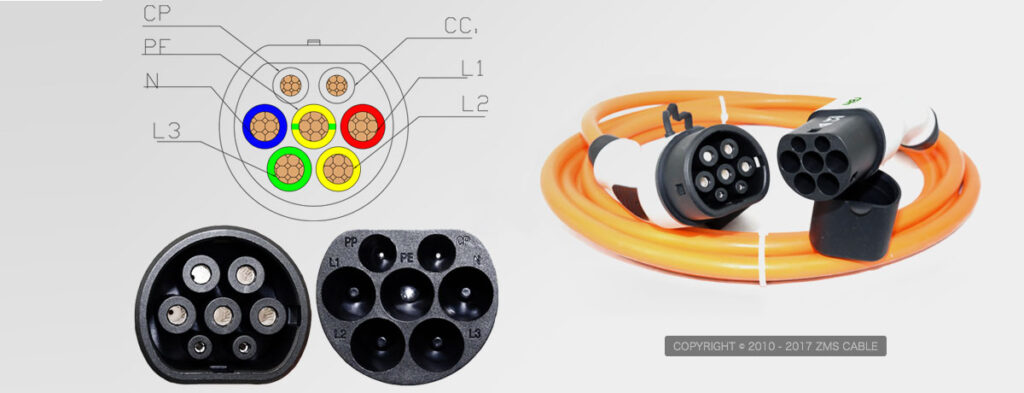
The loading cable for new energy vehicles provide energy to electric cars and can be used for fast recharging and slow recharging.
ZMS Cables offers personalized charging cables for all types of vehicles.
This includes mode 2, the mode 3 and mode 4. The mode 4 is used for high voltage load.
These cables are used in environments such as charging stations, Personal charging equipment and commercial car parks.
We perform safety and electrical performance tests on our cables, compliant with industry standards, to guarantee your safety when using.
Application
1. Charging cable are an essential part of the power transmission process of new energy electric vehicles. They are used to connect the electrical network and the vehicle battery.
2 .Fast charging cables help improve charging efficiency by allowing significant current transfer in a short time.
3. Thanks to their wear-resistant coating, these cables can be used in outdoor charging stations or in bad weather.
4. They also offer good wear resistance and great flexibility, which effectively prevents ground rubbing and repeated stretching.
Product Specification
Driver : oxygen-free copper.
Isolation : PVC, VAT, TPE, EPDM.
Outer sheath : VAT, TPE, elastic rubber sheath.
Tension nominale : 450/750V
Driver resistance (ΩKM) : 3.33 – 7.95
Finished weight (kg/km) : 188- 385
Operating temperature : -40℃ – 90℃
Radius of curvature : ≥6D
Normal
IEC 61851-1,GB/T 33594-2017,SAE J1772
Product Features
High resistance to high temperatures : Due to heat generation during charging, charging cables can work safely and stably at temperatures below 90°C, thus ensuring the safety and stability of the charging process.
Excellent resistance to oils : Resists mineral oils, with gasoline, diesel, with hydraulic oils, to aqueous solutions, etc.
High wear resistance : The cable sheath has excellent wear resistance. After repeated rubbing on the ground, the sheath has no cracks or breaks.
Excellent immunity to interference : Resists electromagnetic interference, reducing energy losses and guaranteeing transmission quality.
Great flexibility : The cable does not short circuit or break after repeated bending. He's staying flexible even in cold weather, guaranteeing the integrity of the sheath.
How to Choose a Charging Cable
1. Select a suitable location for installation, like your garage or yard.
2. If you want to use slow charging to protect the battery, you can opt for a slow-charging home charging station. The rated capacity of the cable can be 16A or 32A.
3. Charging cable specifications are not uniform. It is important to take into account the type of charging connector in your vehicle and choose the appropriate connector.
4. The length of the cable can be determined based on the location of the charging station and the position of the charging socket on your vehicle. In general, a cable length of 7 meters is recommended.
